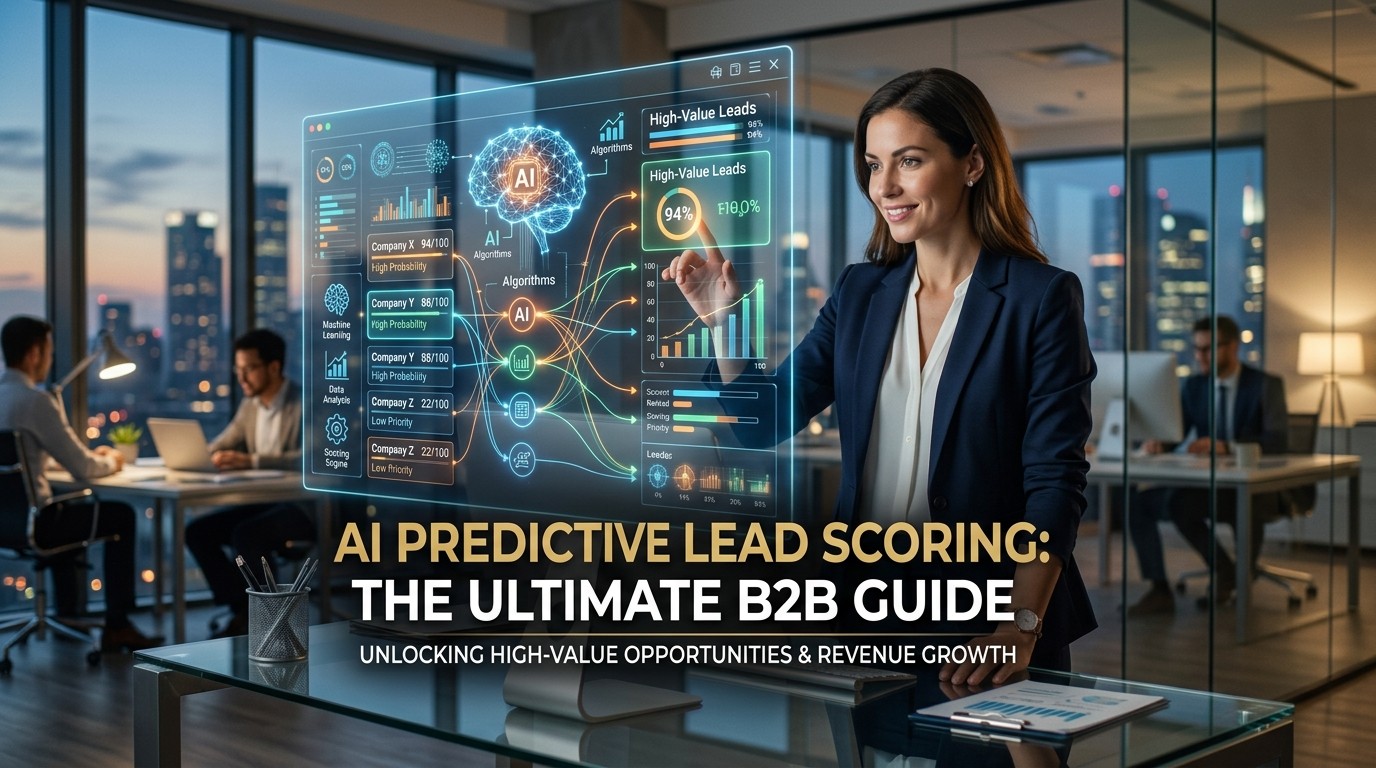
A strong AI Predictive Lead Scoring system helps B2B teams identify buying intent earlier, prioritize better-fit leads, and connect marketing effort to real revenue outcomes with less wasted motion.
AI Predictive Lead Scoring has become one of the most practical ways to cut through noisy funnels and find the contacts most likely to become customers. HubSpot’s current scoring documentation shows that lead scores can be built from engagement, fit, or combined criteria, while Salesforce explains that Einstein Lead Scoring uses machine learning to discover your organization’s conversion patterns and prioritize leads that resemble past winners. That means AI Predictive Lead Scoring is not a vague concept anymore; it is a working method inside major CRM and marketing systems that helps teams focus on the leads that actually matter.
AI Predictive Lead Scoring matters for psychology as much as operations. Sales teams feel less friction when they know where to spend their time, and marketing teams feel less guesswork when campaign quality can be measured against likely conversion instead of only lead volume. A mature AI Predictive Lead Scoring process turns the CRM into a decision aid rather than a storage bin. It helps the organization see who is showing genuine buying behavior, who is only browsing, and who should move forward immediately. That clarity reduces stress and raises the quality of the next action.
What predictive scoring is actually doing
At its core, AI Predictive Lead Scoring looks at historical conversion data and infers which current leads share the same signals as earlier customers. Salesforce says predictive lead scoring uses past interactions, purchase patterns, and engagement levels to rank leads by likelihood to convert, and its Einstein documentation says the model studies your organization’s conversion patterns and refreshes scores on a regular cadence. HubSpot’s guidance similarly shows that scoring can combine engagement and fit, with AI scoring available in certain tiers. In other words, AI Predictive Lead Scoring is pattern recognition applied to revenue behavior.
AI Predictive Lead Scoring is valuable because it can look at combinations instead of isolated actions. A single page view may mean little, but a repeated visit to pricing, a demo request, and a title that matches the ideal account profile can together signal something much stronger. That is the basic promise of AI Predictive Lead Scoring: it identifies the mix of signals that most often appears before a deal progresses. Human judgment still matters, but the model helps the team spot the pattern earlier and with less bias from memory or anecdote.
The data foundation you need

The accuracy of AI Predictive Lead Scoring depends heavily on the quality of the data underneath it. HubSpot’s scoring docs make this clear by showing that scores can be built from record actions and properties, and that AI scoring needs enough converted and non-converted records to train properly. If the CRM is full of duplicates, inconsistent fields, missing values, or messy source tracking, AI Predictive Lead Scoring may still run but its output will be harder to trust. Clean data is not glamorous, but it is the bedrock of every reliable scoring model.
This is where your AI Lead Scoring Blueprintl matters. Before the model ranks anyone, the team needs to define what “good fit” means, which behaviors show true intent, and which fields are dependable enough to use. A blueprint should map company size, industry, role, website behavior, email engagement, and high-value conversion events in a way that reflects the real sales process. AI Predictive Lead Scoring works best when the inputs are disciplined, because a sophisticated model can still produce misleading confidence if the underlying records are weak.
AI Predictive Lead Scoring also improves when the team separates fit from behavior. Fit data tells you who the lead is; behavior data tells you what the lead has done. HubSpot’s framework explicitly supports engagement scores, fit scores, and combined scores, which is a useful model for keeping those categories distinct. If the team mixes them carelessly, the score becomes difficult to explain. If the team keeps them separate, AI Predictive Lead Scoring becomes much easier to tune, debug, and trust over time.
How the model learns patterns
AI Predictive Lead Scoring learns from historical outcomes. Salesforce says Einstein Lead Scoring analyzes your past leads to find commonalities with leads that have already converted, and its help documentation notes that scores are refreshed regularly so new trends do not get missed. That matters because B2B behavior changes as offers, channels, and market pressure change. AI Predictive Lead Scoring is only useful when the model keeps learning from new evidence instead of freezing old assumptions into the workflow.
The learning process is not magic. AI Predictive Lead Scoring is really a structured way of saying that the system has found relationships between attributes and outcomes that are too complex or too numerous for a human to manage casually. The model may discover that certain job titles, industries, or behavior sequences show up repeatedly in closed-won deals. It may also discover that some signals look important but actually contribute little. AI Predictive Lead Scoring matters because it turns these hidden relationships into prioritization logic that the team can use every day.
The best teams do not treat AI Predictive Lead Scoring as a black box. They ask what it is optimizing, what data it uses, and how often it gets refreshed. HubSpot’s AI scoring guidance shows that the model trains on evaluated contacts and needs enough sample size to generate a useful score, which means the business’s own data maturity matters just as much as the software. If the sample is thin, AI Predictive Lead Scoring can only do so much. If the sample is rich and consistent, the model becomes much more dependable.
The blueprint behind the system
A strong AI Predictive Lead Scoring process needs a blueprint, not just a feature switch. The blueprint should define the business goal, the target lead profile, the important behaviors, the thresholds for routing, and the action that happens after the score crosses a line. Without that structure, AI Predictive Lead Scoring may exist technically but fail operationally. The real value comes from linking the score to a clear next step.
The blueprint should also define ownership. Marketing may own campaign inputs, sales may own follow-up behavior, and operations may own routing and data quality. AI Predictive Lead Scoring becomes much more useful when those responsibilities are clear because the team can improve the model without fighting over who caused the result. Shared ownership is good, but specific accountability is better. The system works when people know exactly where their part begins and ends.
The blueprint should also determine how the score will appear in the CRM and workflow tools. HubSpot says score properties can be used in workflows, segments, and reports, while Salesforce’s Einstein Lead Scoring adds a Lead Score field to help sellers prioritize their leads. That means AI Predictive Lead Scoring is not just a metric. It should shape routing, segmentation, notifications, and reporting so the business can act quickly on the signal.
Fit, behavior, and intent
AI Predictive Lead Scoring works best when fit and behavior are both present. HubSpot’s scoring model shows how engagement criteria and fit criteria can be separated and combined, which is a practical way to understand buying quality. A lead may be active but still be a poor match, while another lead may have a perfect fit and only modest activity. AI Predictive Lead Scoring is valuable because it helps the team see both sides of that equation rather than overreacting to one signal alone.
A common mistake is to reward too many shallow actions. AI Predictive Lead Scoring should not overvalue a one-time email open or a casual page visit if those behaviors do not correlate strongly with conversion in your own data. The model should prioritize signals closer to buying behavior, such as demo requests, repeated high-intent visits, and meaningful content engagement. That helps the sales team spend time where the probability of action is actually higher. AI Predictive Lead Scoring is strongest when it points toward readiness, not just activity.
AI Predictive Lead Scoring also improves when the company understands segment differences. A target account in one industry may need one threshold, while another region or product line may need another. HubSpot explicitly supports multiple scores for different objects and teams, which is useful because one scoring logic rarely serves every use case equally. When the business has multiple motions, the scoring system should reflect that reality instead of forcing everyone into one generic model.
Predictive scoring versus manual rules
The phrase Predictive Lead Scoring vs Traditional Methods matters because the two approaches solve the same problem in different ways. Traditional scoring uses manually assigned points. Predictive scoring uses machine learning to infer which patterns matter most based on historical outcomes. Salesforce says predictive lead scoring can be faster and more accurate than traditional rules-based approaches, which is a useful summary of why many teams are moving in this direction.
Traditional scoring still has value. It is easy to explain, easy to implement, and often enough for teams that are just getting started. But it can become rigid because humans tend to overvalue obvious actions and undervalue subtle combinations that really predict conversion. In contrast, AI Predictive Lead Scoring can identify patterns the team would not have guessed, especially when the buying cycle is long or the funnel is complex. The tradeoff is that the model needs enough history to learn from, and the team needs enough trust to use it consistently.
| Dimension | Traditional Scoring | Predictive Scoring |
|---|---|---|
| Logic | Manually assigned rules | Machine-learned patterns |
| Maintenance | Human updates | Continual refresh |
| Transparency | Easier to explain | Needs explanation layer |
| Scale | Limited by manual effort | Better at larger volumes |
| Accuracy over time | Can drift | Can improve with more data |
AI Predictive Lead Scoring does not have to replace rules completely. In many organizations, the smartest answer is a hybrid. The rules layer captures obvious business priorities, while the predictive layer adds adaptive insight. That hybrid approach is especially helpful when sales cycles are complicated or when multiple stakeholders influence the deal. AI Predictive Lead Scoring becomes most useful when the business chooses the right mix of clarity and adaptability instead of trying to force one method to solve everything.
What to score and what to ignore
AI Predictive Lead Scoring should reward meaningful behavior rather than every click. HubSpot’s scoring documentation shows that engagement scores can include site visits, newsletter subscriptions, CTA clicks, and email opens, while fit scores use property values like job title, company size, or annual revenue. That distinction is useful because it keeps the team honest about what kind of signal is being measured. AI Predictive Lead Scoring should not confuse casual attention with purchase intent.
A strong model usually focuses on signals closer to real buying motion. AI Predictive Lead Scoring should pay attention to repeated visits to important pages, deeper content consumption, direct form fills, event attendance, and responses that show a willingness to engage. A lead who touches many light signals may still be less valuable than a lead who shows one or two very strong signals. The point is not to chase activity. The point is to rank the activity that most often precedes a real opportunity.
AI Predictive Lead Scoring also works better when the company understands account context. A lead from a strategic target account may deserve a different threshold from a lead in a low-priority segment. If the company serves multiple regions or product lines, it may even need several scoring versions. HubSpot’s documentation explicitly notes that multiple scores can be created for different objects or teams, which is a reminder that AI Predictive Lead Scoring should reflect your real operating structure instead of pretending every lead behaves identically.
How to validate the score
Validation is where AI Predictive Lead Scoring proves its value. The team should compare score tiers against actual conversion outcomes and ask whether higher scores consistently turn into stronger opportunities. Salesforce’s Einstein documentation includes dashboards such as average lead score by source and conversion rate by score, which is a very practical model for how to review performance. If the top scores do not convert better, the model needs attention.
AI Predictive Lead Scoring should also be reviewed with sales feedback. Reps can usually tell when the score is aligned with reality and when it is overweighting behavior that does not move the deal forward. That feedback matters because the model may be statistically sound but still operationally awkward. A score only becomes valuable when people trust it enough to use it in the field. AI Predictive Lead Scoring works best when the predictive output and the selling experience agree.
The review cycle should be ongoing. HubSpot’s scoring documentation shows that score properties can feed workflows, reports, and segmentation, which makes it easy to keep the score visible after launch. AI Predictive Lead Scoring should never be built once and forgotten. It should be monitored as campaigns, messaging, and market conditions change so that the model keeps matching the real buying environment.
Integrating Paid Ads
Integrating Paid Ads into a predictive scoring system is useful because ad clicks alone do not reveal lead quality. The real question is which campaigns create contacts that look and behave like customers. AI Predictive Lead Scoring helps expose that difference quickly. If a channel generates a lot of weak-fit traffic, the score will show it. If another channel generates fewer leads but higher-quality opportunities, the score will make that visible too.
Integrating Paid Ads also helps the team optimize creative and targeting. If certain audiences, keywords, or ad promises consistently create better-scoring leads, the marketing team can shift budget toward them. That turns paid media into a learning loop rather than a spend loop. AI Predictive Lead Scoring makes paid marketing more accountable because the success metric moves beyond cheap lead capture and toward actual pipeline quality.
AI Predictive Lead Scoring is especially valuable when paid campaigns feed a CRM with enough behavioral detail to support smarter routing. The score can tell the team whether the lead should go into sales, nurture, or a lower-priority path. That means ad money is not wasted on traffic that looks good in the ad dashboard but goes nowhere in the pipeline. Integrating Paid Ads with the scoring system therefore improves both acquisition efficiency and the quality of downstream follow-up.
How the score supports the B2B Demand Gen Engine

A B2B Demand Gen Engine becomes much stronger when scoring is part of it from the beginning. Demand generation is not just about creating visibility. It is about creating the right kind of demand that can actually move through sales. AI Predictive Lead Scoring helps by showing which campaigns, formats, and touchpoints are producing real momentum and which ones are only adding noise.
The engine gets smarter when it uses score data to refine content and channel strategy. If a webinar, guide, or comparison page creates stronger leads than a social campaign with the same traffic volume, the team learns what deserves more investment. AI Predictive Lead Scoring becomes a feedback system between campaign design and revenue quality, which is exactly what a strong B2B Demand Gen Engine should provide. It keeps the company from mistaking attention for opportunity.
Marketing automation platforms already frame the same principle. Adobe Marketo says it can identify the best fit and most engaged prospects with sophisticated lead scoring and can deliver buyer engagement data directly to sales teams in the CRM. That integration matters because a B2B Demand Gen Engine works best when the signal can move smoothly from marketing to sales and then into reporting.
Where the AI Lead Scoring Blueprint fits operationally
The AI Lead Scoring Blueprint should be the document or working model that connects data, scoring logic, workflow, and ownership. It should define the data sources, the score thresholds, the routing rules, and the review cycle. AI Predictive Lead Scoring becomes much easier to manage when the blueprint is written down clearly enough for sales, marketing, and operations to use without interpretation gaps. That blueprint is the bridge between idea and execution.
The blueprint should also show what happens after the score changes. HubSpot says score properties can be used in workflows, segments, and reports, while Salesforce Einstein adds a Lead Score field that helps reps prioritize by similarity to prior converted leads. AI Predictive Lead Scoring should therefore trigger real work: owner assignment, alerts, nurture changes, or review queues. A score that does not change behavior is just decoration.
AI Predictive Lead Scoring should also be explained in human language. Sales reps are more likely to trust the system if they know what types of behaviors tend to raise the score and what the score is actually trying to predict. That does not mean the model must be simplistic. It means the model should be understandable. A good blueprint makes the score feel like a guide, not a mystery.
The role of decay, freshness, and timing
AI Predictive Lead Scoring is stronger when it respects timing. Old behavior should not always count the same as recent behavior. HubSpot’s scoring documentation explains score decay and shows that points can diminish over time, which is a practical way to keep scores fresh and aligned with current intent. This matters because a lead who was active months ago may not be as ready today. AI Predictive Lead Scoring should reflect recency as part of the model.
Timing also matters from a buyer psychology perspective. A lead who interacted this week is often more actionable than a lead who interacted last quarter. AI Predictive Lead Scoring helps the team respond while the signal is still alive. That can improve conversion because fast, relevant follow-up usually performs better than delayed follow-up. The score should therefore function as a timing detector as much as a quality detector.
Recency rules also help keep the CRM clean. Without decay or refresh, the score can overstate old interest and understate new behavior. Salesforce’s Einstein documentation notes that scores refresh regularly, which is another reminder that the model should stay current. AI Predictive Lead Scoring is useful because it treats freshness as part of the opportunity rather than as an afterthought.
Common implementation mistakes
The biggest implementation mistake in AI Predictive Lead Scoring is poor data discipline. If records are messy, duplicated, or inconsistently labeled, the model can still run but its output becomes less trustworthy. HubSpot’s scoring guidance and Salesforce’s Einstein documentation both make it clear that scoring depends on the historical data available to the system. Clean inputs are not optional. They are the reason the score can be believed.
Another mistake is ignoring segmentation. A single score can be a good start, but different regions, products, and account types often need different logic. HubSpot explicitly supports multiple lead scores for different teams or regions, which shows that one-size-fits-all scoring is not the only option. AI Predictive Lead Scoring should reflect the actual way the business sells, not an oversimplified version of it.
A third mistake is failing to communicate the score to the people who need it most. If sales does not understand why a lead is prioritized, the team may ignore the system. AI Predictive Lead Scoring works best when the output is visible, explainable, and tied to the day-to-day work of the reps. Without adoption, even a strong model delivers little business value.
How to start without overcomplicating it
The easiest way to launch AI Predictive Lead Scoring is to start with one lead type, one team, and one outcome. For example, a team can begin with inbound leads, compare score tiers against conversion rates, and then review which behaviors are most associated with sales-ready opportunities. That narrow launch keeps the project manageable while still creating useful learning.
Once the first version is working, the team can add more signals. HubSpot and Salesforce both show that the scoring framework can grow in sophistication over time as more data and more context become available. AI Predictive Lead Scoring does not need to be perfect on day one. It just needs to be useful enough to improve decision-making and strong enough to justify the next iteration.
The early version should prioritize clarity over complexity. Every stakeholder should know what makes the score rise, what makes it fall, and what happens when the score crosses a threshold. If the team understands the logic, it will trust the process sooner. AI Predictive Lead Scoring becomes far easier to improve when the first version is simple enough to explain without a long training session.
Connecting AI to the revenue workflow
AI Predictive Lead Scoring works best when it is tied directly to routing and follow-up. A high score should trigger owner assignment, a task, a notification, or a prioritization change. HubSpot’s scoring properties and workflow support are a useful example of how scoring should connect to real work. Salesforce’s Einstein score field serves the same purpose by helping reps prioritize leads that are most similar to prior converted leads.
The workflow also needs to handle leads that drop out of the active zone. A score that falls or goes stale should move the contact back into nurture or a lower-priority queue. That prevents the sales team from staying stuck on weak opportunities. AI Predictive Lead Scoring becomes much more valuable when it helps the team both accelerate promising leads and cool off unlikely ones. That keeps the revenue motion focused.
This is where reporting, sales, and marketing all connect. The score should tell the team not only who to call, but also which channels, content assets, and campaign types are producing the best-fit leads. Adobe Marketo’s product positioning around engagement data and CRM sync points to this same principle: the score becomes most useful when the signal moves cleanly between systems.
Why AI matters without replacing strategy
AI Predictive Lead Scoring adds value because it can notice combinations of signals that are hard for humans to track consistently. Salesforce says machine learning can find conversion patterns in your own lead history, which can improve prioritization as the funnel gets more complicated. That speed and pattern recognition are real advantages. Still, the model needs strategy to tell it what matters in the first place.
Strategy defines the target. If the business sells to different industries, then industry fit must matter. If the buying cycle is long, then recency and engagement depth may matter more. If the product is highly technical, then job role or function may carry more weight. AI Predictive Lead Scoring is strongest when the team already understands its market well enough to ask the right question and select the right signal.
AI also needs governance. HubSpot’s AI scoring guidance shows that the model depends on enough evaluated contacts to train properly, which means the business should not expect a miracle from thin data. AI Predictive Lead Scoring becomes reliable when the company is disciplined about data quality, review cycles, and operational adoption. AI helps the process, but strategy still decides the destination.
What the score should change in practice
AI Predictive Lead Scoring should change behavior, not just reporting. If the score is high, the lead should move faster into the right hands. If the score is low but the lead is still engaging, the contact should stay in nurture instead of taking up sales time. The whole point of the system is to improve prioritization so the team spends more time on likely buyers and less time on weak signals.
AI Predictive Lead Scoring should also improve campaign decisions. If one channel creates more high-scoring opportunities than another, the marketing team should know that quickly. That insight helps budget allocation, content design, and channel planning. The score becomes a kind of quality report on the demand engine itself, which is exactly the kind of intelligence a revenue organization needs.
It should also improve management conversations. Instead of asking whether a campaign got “enough leads,” the team can ask whether it generated the right leads. AI Predictive Lead Scoring makes that conversation possible by connecting behavior to likelihood. That leads to better decisions because the team can finally compare volume, quality, and revenue potential in one framework.
Measurement and optimization

The best way to optimize AI Predictive Lead Scoring is to compare score tiers against real outcomes over time. Salesforce’s Einstein reports, including average score by lead source and conversion rate by score, show the kind of view leaders should want. If the highest scores convert more often, the system is doing useful work. If they do not, then the model needs new inputs, new thresholds, or a different definition of fit.
AI Predictive Lead Scoring should also be reviewed with sales reps and operations teams. The number may look strong on paper but still be awkward in the field. Maybe the score is too broad. Maybe it overweights one campaign. Maybe it is not reflecting recent changes in the market. The review process should be collaborative because the score affects multiple parts of the funnel, not just one dashboard.
Optimization also includes decay, refresh, and threshold tuning. HubSpot’s scoring docs describe score decay and score limits, which help prevent stale behavior from dominating the result. That is a useful reminder that AI Predictive Lead Scoring is not static. It should be continuously adjusted so the score stays aligned with current buyer behavior.
Scaling the model responsibly
AI Predictive Lead Scoring becomes more powerful as the business grows, but scale should not happen recklessly. More channels, more products, and more regions usually mean more complexity. The solution is not to make the model noisier. The solution is to structure it better. HubSpot’s support for multiple scores, groups, and thresholds is useful here because it shows how scoring can expand without losing clarity.
A mature model should also stay explainable. As scoring becomes more advanced, the business still needs to understand why certain leads rank higher. If the score becomes too opaque, adoption drops. AI Predictive Lead Scoring scales best when the team can still explain the logic, even if the model itself is powered by machine learning. That combination of sophistication and transparency is what makes the system durable.
It also helps to remember that scale changes the role of the score. At low volume, the score may simply help route leads. At higher volume, AI Predictive Lead Scoring becomes a resource allocation system that shapes staffing, campaign design, and revenue forecasting. The bigger the funnel gets, the more useful the score becomes as a stabilizer for the entire motion.
Conclusion
AI Predictive Lead Scoring works best when clean data, clear fit logic, meaningful behavior signals, and actionable workflows all come together. HubSpot, Salesforce, and Adobe all point toward the same practical truth: scoring is most useful when it helps teams prioritize better, route faster, and focus on the leads most likely to convert. In that sense, AI Predictive Lead Scoring is not just a feature. It is part of the revenue operating system. When the blueprint is clear and the model is reviewed regularly, the score becomes easier to trust, easier to improve, and much more valuable for both marketing and sales. It is not about predicting everything perfectly. It is about making the next decision smarter.
Frequently Asked Questions (FAQ)
1. What is AI Predictive Lead Scoring?
AI Predictive Lead Scoring is a machine-learning approach that ranks leads by their likelihood to convert based on historical patterns, fit data, and engagement behavior.
2. How is it different from traditional scoring?
Traditional scoring uses manually assigned points, while predictive scoring learns from historical outcomes and adjusts patterns automatically. Salesforce says predictive scoring can be faster and more accurate than rules-based scoring.
3. What data does it use?
AI Predictive Lead Scoring usually uses a mix of engagement data, fit data, and conversion history. HubSpot’s lead scoring framework shows these categories clearly.
4. How much data is needed?
HubSpot says AI scoring requires enough evaluated records to train the model, and its documentation gives a minimum sample size requirement for AI score generation in the relevant workflow.
5. Can it work inside CRM workflows?
Yes. HubSpot says score properties can be used in workflows, segments, and reports, and Salesforce’s Einstein scoring adds a Lead Score field for prioritization.
6. How often should the model update?
Salesforce’s Einstein Lead Scoring documentation says the model reanalyzes lead data every 10 days so new trends are not missed.
7. Can it support paid advertising?
Yes. AI Predictive Lead Scoring helps identify which paid campaigns generate the best leads, not just the most clicks, which makes budget decisions smarter.
8. How does it help demand generation?
It shows which campaigns produce high-quality opportunities, so the B2B Demand Gen Engine can focus on the channels and messages that actually create pipeline. Adobe Marketo’s product messaging reflects this same idea.
9. What is the most common mistake?
The most common mistake is using poor-quality data or too many weak signals, which reduces trust in the score and makes the output less useful.
10. Do I still need strategy if AI is doing the scoring?
Yes. AI Predictive Lead Scoring helps the team prioritize, but strategy still decides which behaviors matter, how thresholds work, and how the score fits the sales process.