
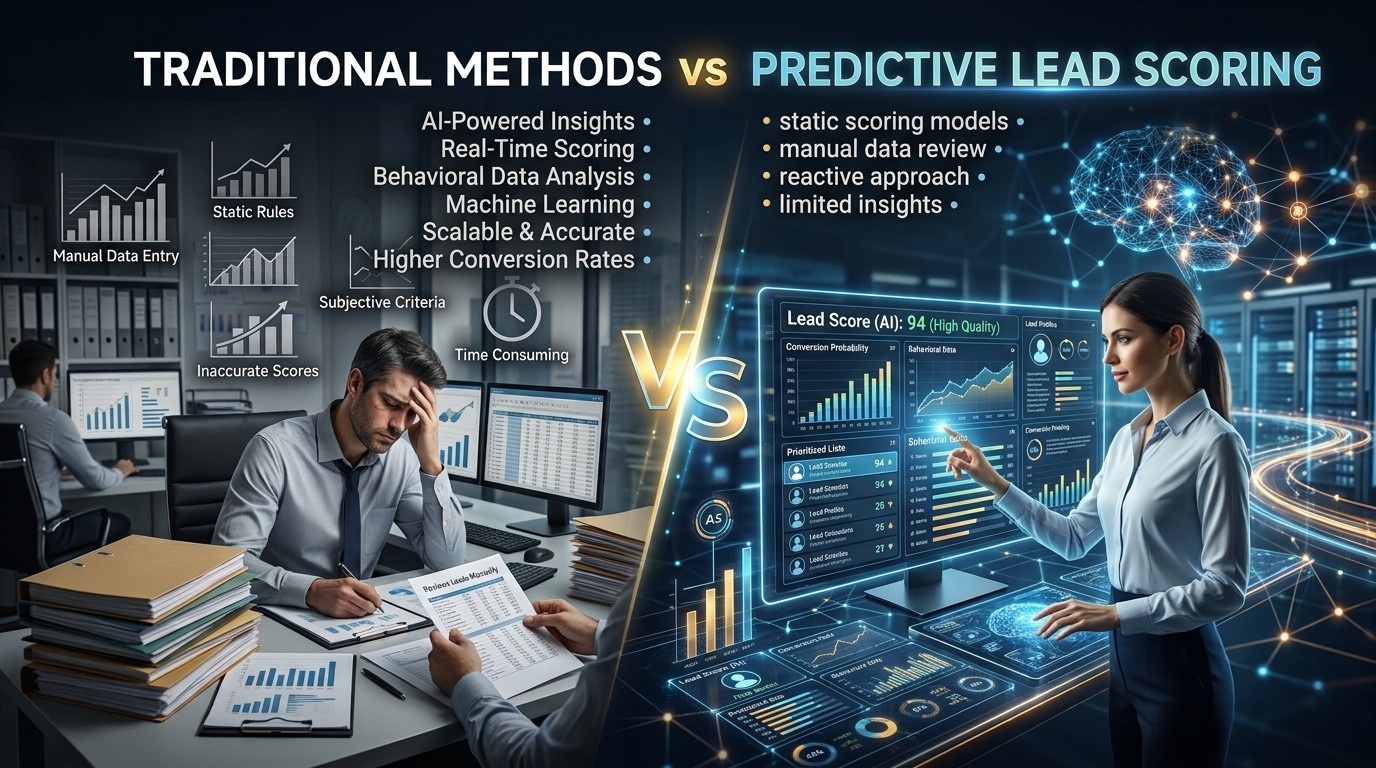
This guide explains how teams can prioritize leads more accurately, reduce wasted effort, and improve sales outcomes by comparing rule-based qualification with data-driven prioritization.
Predictive Lead Scoring vs Traditional Methods matters because sales teams do not lose revenue only when they miss leads; they lose revenue when they spend too much time on the wrong leads. When the pipeline is full, it can feel productive even if very little is actually moving forward. The real problem is not volume but prioritization, and that is where this comparison becomes important.
Predictive Lead Scoring vs Traditional Methods changes how teams think about attention. Traditional systems often depend on assumptions made by humans, while predictive systems use patterns from past outcomes to rank what deserves focus first. That shift affects conversion, speed, morale, and forecasting. It also changes how marketing and sales define “qualified,” which can be the difference between busy work and real growth.
Predictive Lead Scoring vs Traditional Methods is not only a technology question. It is also a process question. A company with weak data habits, unclear handoffs, or poor follow-up discipline will struggle with either approach. The scoring method can improve prioritization, but it cannot replace strategy. That is why the best teams treat scoring as part of a larger revenue system.
Predictive Lead Scoring vs Traditional Methods becomes especially relevant when lead volume grows faster than human judgment can keep up with. Early-stage teams may think manual review is enough, but that approach starts to break down as soon as inbound activity rises. Once there are too many leads to inspect deeply, the quality of scoring directly shapes opportunity creation.
What traditional lead scoring actually does
Traditional lead scoring usually assigns points based on rules that people create by hand. A lead might gain points for job title, company size, page visits, form fills, email clicks, or webinar attendance. Predictive Lead Scoring vs Traditional Methods begins here because traditional scoring depends on the team deciding, in advance, what matters most.
Traditional lead scoring can work well when the market is simple and the funnel is stable. If the buying journey is short and the signals are obvious, rules may be enough. Predictive Lead Scoring vs Traditional Methods becomes more useful as complexity rises, because hand-built rules tend to oversimplify how buyers behave across time and channels.
Traditional systems often feel intuitive because they are easy to explain. Sales and marketing can see the logic directly, and that transparency builds comfort. Predictive Lead Scoring vs Traditional Methods challenges that comfort by showing that intuitive rules are not always the most accurate rules. A model may detect combinations that a human would miss.
Traditional scoring also tends to reflect the biases of the people who build it. If the team believes title matters most, title gets too much weight. If they think activity is the strongest signal, behavior may be overvalued. Predictive Lead Scoring vs Traditional Methods is useful because it reduces the need to guess which signals deserve attention before the data has been tested.
How predictive lead scoring works

Predictive scoring looks at historical outcomes and finds patterns that are linked to conversion, revenue, or other desired results. Instead of asking the team to guess the rules, it learns from examples. Predictive Lead Scoring vs Traditional Methods matters here because the predictive approach can reveal that some subtle combinations are much more important than obvious single signals.
Predictive systems usually consider more variables than rule-based systems. They may incorporate behavioral activity, firmographic fit, engagement depth, content interest, timing, sequence, and even how leads compare to closed-won deals. Predictive Lead Scoring vs Traditional Methods becomes stronger when the model can weigh many factors together instead of relying on a few manual assumptions.
Predictive systems are also better at handling change. As the market evolves, the model can be retrained or refreshed. Predictive Lead Scoring vs Traditional Methods is compelling because business conditions shift faster than static rules do. A rule that worked six months ago may become less useful when audience behavior changes, product positioning shifts, or new channels appear.
Predictive scoring is not magic, though. It is only as good as the data behind it. Predictive Lead Scoring vs Traditional Methods should therefore be understood as a tradeoff between human simplicity and statistical learning. The model can improve consistency, but it still needs clean inputs, sufficient history, and thoughtful implementation.
The psychology of prioritization
Sales teams want clarity, not just data. Predictive Lead Scoring vs Traditional Methods is powerful because it influences what people decide to do first, and that affects energy. When a rep believes a lead is likely to convert, they approach the conversation with more focus and confidence. When a lead feels low-priority, follow-up often slips.
Predictive Lead Scoring vs Traditional Methods also changes the emotional experience of marketing teams. If the scoring system is opaque, people may resist it. If the rules are visible, they may trust it more quickly. That tension matters because adoption is not purely technical. Teams support what they understand and what helps them win.
Predictive Lead Scoring vs Traditional Methods can also reduce decision fatigue. Human beings do not like making repeated judgment calls under pressure. A reliable scoring framework lowers the mental cost of prioritization. That matters in fast-moving sales environments where every hour spent on the wrong lead can create hidden opportunity cost.
Predictive Lead Scoring vs Traditional Methods becomes most valuable when it turns uncertainty into confidence. It does not remove human judgment, but it gives human judgment a better starting point. That shift is psychologically meaningful because people perform better when they have a useful ranking instead of a long, unfiltered list.
Data inputs that shape scoring
Predictive Lead Scoring vs Traditional Methods depends heavily on the quality and variety of data available. Traditional scoring often focuses on visible actions such as form fills or email clicks. Predictive systems can go further by combining historical conversion patterns with behavioral, demographic, and company-level data to identify stronger signals.
Predictive Lead Scoring vs Traditional Methods becomes more accurate when the inputs include both fit and intent. Fit tells you whether the lead resembles prior winners. Intent tells you whether the lead is actively moving. A great model usually looks for both, because a lead can be well-matched but inactive, or highly active but poorly matched.
Predictive Lead Scoring vs Traditional Methods also raises questions about data hygiene. If CRM records are inconsistent, duplicate, or incomplete, the model can learn the wrong lessons. Traditional scoring can survive imperfect data for a while because humans fill in the gaps, but predictive systems need clearer structure to avoid misleading patterns.
Predictive Lead Scoring vs Traditional Methods should therefore begin with an audit. If the team cannot trust the underlying data, the scoring result will not be reliable enough to drive action. This is why strong data management is not optional; it is part of the scoring strategy itself.
A practical comparison table
| Area | Traditional scoring | Predictive scoring |
|---|---|---|
| Setup | Manual rule creation | Model trained on outcomes |
| Flexibility | Limited | Higher, with retraining |
| Transparency | Easy to explain | Sometimes less obvious |
| Accuracy potential | Moderate | Often higher with good data |
| Maintenance | Human updates required | Monitoring and model refresh required |
| Best fit | Simple funnels | Complex funnels |
Predictive Lead Scoring vs Traditional Methods becomes easier to understand when you compare how each approach handles change. Traditional scoring is simpler to inspect, while predictive scoring is more adaptive. The best choice depends on the sophistication of the business, the quality of the data, and the need for precision.
Predictive Lead Scoring vs Traditional Methods should not be framed as a fight between good and bad. It is better understood as a question of fit. A startup with a light funnel may need rules, while a scaling company with many touchpoints may need a model. The right method is the one that matches the complexity of the buying process.
Predictive Lead Scoring vs Traditional Methods also affects training. New team members often learn traditional rules faster because they can see the logic directly. Predictive models may require more explanation, but they can produce better prioritization once trust is established. That means implementation is not just about software; it is about team education.
Predictive Lead Scoring vs Traditional Methods often delivers the biggest value when sales capacity is limited. If a team can only act on a small number of leads, ranking quality becomes critical. In that situation, the cost of misclassification is high, so better prioritization has a direct revenue impact.
Where traditional methods still make sense
Predictive Lead Scoring vs Traditional Methods does not eliminate the value of rules. Traditional scoring still makes sense when the company is early, the dataset is small, or the buying behavior is very predictable. In those settings, simple rule logic can be enough to keep the process moving without unnecessary complexity.
Predictive Lead Scoring vs Traditional Methods should also be viewed through an operational lens. Sometimes the issue is not model accuracy but internal readiness. If the team does not have enough historical data or enough process maturity to act consistently, a traditional system can be a better temporary fit.
Predictive Lead Scoring vs Traditional Methods is also about speed to implementation. A rule-based system can be deployed quickly, tested immediately, and adjusted without a long technical setup. That matters for businesses that need a practical starting point before investing in a more advanced system.
Predictive Lead Scoring vs Traditional Methods shows that “traditional” is not the same as “bad.” It can be appropriate, especially in small teams that need clarity more than sophistication. The key is to know when simple scoring is enough and when it has started to limit growth.
Why predictive systems often win at scale
Predictive Lead Scoring vs Traditional Methods becomes more decisive as lead volume and complexity rise. In larger funnels, the number of possible combinations grows fast, and no manual scoring system can keep up perfectly. Predictive models are better at finding patterns across many signals at once.
Predictive Lead Scoring vs Traditional Methods often performs better because the model can learn from outcomes that humans may not notice. A lead might not look impressive on paper, yet it behaves exactly like past buyers in subtle ways. A model can surface that pattern, while a rule set might ignore it.
Predictive Lead Scoring vs Traditional Methods also helps with consistency across teams and markets. Human scoring can vary from one rep to another, especially when sales judgment becomes subjective. Predictive scoring creates a more standardized way to prioritize leads, which supports fairness and repeatability.
Predictive Lead Scoring vs Traditional Methods is especially strong in organizations that care about forecasting. Better prioritization produces better pipeline discipline, and better pipeline discipline supports more accurate revenue expectations. That is one of the main reasons advanced teams invest in the predictive approach.
How sales and marketing alignment improves
Predictive Lead Scoring vs Traditional Methods matters because sales and marketing often disagree about what qualifies as a real opportunity. Marketing may value engagement, while sales may care more about fit and urgency. A well-built predictive system can reduce that tension by grounding prioritization in actual conversion patterns.
Predictive Lead Scoring vs Traditional Methods can improve handoff quality between teams. If both teams work from the same scoring logic, there is less debate about who deserves attention first. That shared understanding helps move leads faster through the funnel and lowers the friction that usually appears when handoffs are vague.
Predictive Lead Scoring vs Traditional Methods also creates a better feedback loop. When sales has a clear scoring signal, it becomes easier to report back on lead quality, follow-up behavior, and deal outcomes. That feedback can then improve both the model and the campaign strategy that feeds it.
Predictive Lead Scoring vs Traditional Methods should therefore be treated as a collaboration tool, not just a ranking tool. The scoring method becomes more useful when it aligns both teams around the same definition of a strong lead. That alignment often improves trust as much as it improves numbers.
Lead scoring in different go-to-market models

Predictive Lead Scoring vs Traditional Methods may play out differently in B2B and B2C environments. In B2B, buying cycles are longer, more stakeholders are involved, and behavioral signals accumulate over time. That makes predictive systems attractive because they can interpret longer, messier journeys more effectively.
Predictive Lead Scoring vs Traditional Methods can also help in highly specialized consumer niches. For example, a Scent Marketing App Guide audience may respond differently from a broad consumer audience because the buying logic is more contextual and use-case driven. Predictive scoring can identify those nuances better than a simple point system.
Predictive Lead Scoring vs Traditional Methods is equally relevant for growth teams building niche software products. A Digital Marketing App for Startup Founders may need to prioritize users who show product-market fit signals rapidly, and predictive scoring can highlight those early behavioral patterns more reliably than static rules.
Predictive Lead Scoring vs Traditional Methods can even be useful in product-led organizations where trial behavior matters more than form fills. In those cases, model-driven scoring can help identify which trial users are most likely to upgrade, adopt, or invite others. That makes the approach more actionable across different growth models.
Building a smart implementation roadmap
Predictive Lead Scoring vs Traditional Methods should be implemented gradually. The first step is deciding what outcome the score is supposed to predict. That may be a meeting booked, a pipeline opportunity, a demo request, a purchase, or a qualified handoff. Without a clear target, the model has no meaningful direction.
Predictive Lead Scoring vs Traditional Methods also requires data preparation. The team should clean records, define the relevant sources, and confirm that the conversion history is trustworthy. This is where an AI Lead Scoring Blueprint can be useful, because a blueprint forces the team to map inputs, outputs, ownership, and operational usage before the model is turned on.
Predictive Lead Scoring vs Traditional Methods should then move into testing. The predictive score should be compared with existing manual logic to see whether it identifies higher-value leads more effectively. The goal is not to replace judgment instantly, but to verify whether the new approach improves prioritization in a measurable way.
Predictive Lead Scoring vs Traditional Methods works best when there is a review process after launch. Scores should not just be generated; they should be monitored. If the model changes behavior in the wrong direction, the team must know early enough to intervene and retrain or adjust the process.
Human judgment still matters
Predictive Lead Scoring vs Traditional Methods should not be interpreted as a choice between people and machines. Human sales judgment is still important because models cannot fully capture every strategic nuance, relationship detail, or market shift. The best outcome usually comes when humans use the score as a guide rather than a final verdict.
Predictive Lead Scoring vs Traditional Methods is strongest when reps use the score to decide where to start, then use their own context to personalize the conversation. A model can say a lead looks promising, but a person still has to understand why that lead matters and how to move the conversation forward.
Predictive Lead Scoring vs Traditional Methods also benefits from override logic. Sometimes a rep knows something the data does not yet know, such as a strategic account relationship, a recent executive change, or a time-sensitive buying trigger. The system should support that kind of informed exception handling.
Predictive Lead Scoring vs Traditional Methods becomes more trustworthy when the organization acknowledges this balance. Neither pure automation nor pure intuition is ideal. The smartest teams combine data signals with human context, then let each correct the weaknesses of the other.
The role of AI in modern scoring
Predictive Lead Scoring vs Traditional Methods is often discussed through the lens of AI because AI can process many signals faster than rule-based logic. That does not mean every model is automatically better, but it does mean the possibility space is much larger. AI can surface interactions that would be difficult for humans to model manually.
Predictive Lead Scoring vs Traditional Methods is also where AI Predictive Lead Scoring becomes especially relevant. In practice, the goal is not just to classify leads, but to estimate which leads are most likely to move forward and why. That can help teams focus on the next best action rather than treating every lead the same.
Predictive Lead Scoring vs Traditional Methods can be enhanced by learning systems that update over time. If the model can be retrained as new outcomes arrive, the scoring logic stays closer to reality. That is especially valuable when product positioning, audience behavior, or market conditions shift.
Predictive Lead Scoring vs Traditional Methods reminds us that AI is only useful when it serves a business decision. The score itself is not the outcome; better action is the outcome. That distinction keeps the team focused on revenue rather than fascination with the technology.
Measuring impact correctly
Predictive Lead Scoring vs Traditional Methods should be judged by business results, not just by how advanced it sounds. The most useful measurements include conversion rate, sales cycle speed, opportunity creation, close rate, and the amount of rep time spent on leads that eventually convert. A better score should improve at least some of those outcomes.
Predictive Lead Scoring vs Traditional Methods may also influence pipeline coverage. If top-ranked leads convert faster, the sales team can fill pipeline more efficiently and forecast with greater confidence. That kind of improvement can matter as much as raw lead volume, especially in teams where resources are tight.
Predictive Lead Scoring vs Traditional Methods should be evaluated before and after implementation. A baseline helps the team know whether prioritization is actually improving. Without a baseline, any later success may simply be assumed rather than proven. Measurement is what turns the scoring method into a management tool.
Predictive Lead Scoring vs Traditional Methods can also be tested by cohort. Some segments may perform better under the predictive model than under traditional rules, while other segments may show little difference. Understanding those variations helps leaders decide where the model adds the most value and where simpler methods still work fine.
Common mistakes teams make
Predictive Lead Scoring vs Traditional Methods often fails when organizations expect the model to solve a deeper process problem. If follow-up is slow, messaging is weak, or the offer is unclear, the score will not fix that. The system can improve prioritization, but it cannot rescue a broken funnel on its own.
Predictive Lead Scoring vs Traditional Methods also fails when teams feed it poor data and then trust the output blindly. If historical records are incomplete or inconsistent, the model may learn misleading patterns. That is why preparation matters just as much as selection. A smart score depends on a smart dataset.
Predictive Lead Scoring vs Traditional Methods can also be undermined by poor adoption. If reps do not trust the ranking, they will ignore it. If managers do not reinforce it, the process will drift back toward habit. A scoring system only matters when the team uses it consistently enough to shape behavior.
Predictive Lead Scoring vs Traditional Methods should be rolled out with education. People need to understand what the score means, what it does not mean, and how it should influence daily work. Without that, even a strong model can feel like a black box that nobody wants to rely on.
Use cases across modern growth teams
Predictive Lead Scoring vs Traditional Methods is especially useful in teams that serve distinct niche audiences. A tool built for startup founders, for example, may need to detect different buying signals than a platform used by enterprise operators. Predictive scoring is helpful because it adapts better to these specific patterns.
Predictive Lead Scoring vs Traditional Methods also appears in specialized B2B products where buyers move through long research phases. Here, the score must recognize subtle engagement such as repeated visits, content depth, and multi-touch interaction. The model can be valuable because it weighs accumulated behavior more accurately than a few manual points.
Predictive Lead Scoring vs Traditional Methods can also support use cases in less obvious product categories. A Scent Marketing App Guide audience might respond to certain educational and commercial signals that a traditional ruleset would never prioritize correctly. In niche markets, that specificity can make the difference between wasted attention and real opportunity.
Predictive Lead Scoring vs Traditional Methods helps teams understand that lead quality is contextual. A lead that looks weak in one product line may be strong in another. Predictive systems are often better at adapting to that reality because they evaluate patterns in context rather than relying on universal assumptions.
Governance, bias, and accountability
Predictive Lead Scoring vs Traditional Methods should be managed responsibly. Any system that influences sales attention can create bias if it is not monitored carefully. If the training data reflects historical favoritism, the model may repeat that bias. The organization has to watch not only for accuracy but also for fairness and consistency.
Predictive Lead Scoring vs Traditional Methods should include governance rules about who can change the model, how often it is reviewed, and what happens when results look suspicious. That structure keeps the scoring system from drifting or becoming a silent source of bad decisions. Accountability is part of good design.
Predictive Lead Scoring vs Traditional Methods should also be transparent enough for people to question it. Teams do not need every technical detail, but they do need enough explanation to understand why the score changed. A scoring system that cannot be examined can become difficult to trust, even if it is technically strong.
Predictive Lead Scoring vs Traditional Methods works best in organizations that treat scoring as a living process. The model should be monitored, checked against outcomes, and updated when needed. That kind of discipline keeps the system useful as the market evolves and prevents stale logic from becoming policy.
How to choose the right approach

Predictive Lead Scoring vs Traditional Methods should be decided by business maturity, data quality, funnel complexity, and team readiness. A smaller team with limited history may do perfectly well with traditional rules for now. A larger team with enough data and enough operational discipline may benefit from predictive ranking much more.
Predictive Lead Scoring vs Traditional Methods is easiest to evaluate by asking one simple question: do we need better intuition, or do we need better pattern recognition? If the lead flow is simple, rules may be enough. If the flow is complex and the stakes are high, prediction may deliver stronger results.
Predictive Lead Scoring vs Traditional Methods is also influenced by tooling and team capability. Some companies have the infrastructure to maintain a model and act on the output. Others need a lighter system that is easier to explain and maintain. The right method is the one the organization can actually use well.
Predictive Lead Scoring vs Traditional Methods should finally be chosen with an eye on growth. If improving lead quality, prioritization speed, and forecast confidence will materially change outcomes, then the predictive route may be worth the extra effort. If not, a cleaner traditional process may be the wiser starting point.
Closing perspective
Predictive Lead Scoring vs Traditional Methods is ultimately about helping teams spend their time better. A scoring method should not exist to impress anyone; it should exist to improve who gets attention, when they get it, and how consistently the team acts on it. That is why the real value lies in prioritization.
Predictive Lead Scoring vs Traditional Methods shows that traditional logic can still be useful, but predictive systems often become more powerful as data, complexity, and scale increase. The best teams do not worship either approach. They choose the method that fits their funnel, their data, and their capacity to execute.
Predictive Lead Scoring vs Traditional Methods becomes a strategic advantage when it helps sales and marketing focus on the leads that are most likely to become real revenue. When that happens, the scoring method stops being a back-office setting and becomes part of how the business grows.
Conclusion
Predictive Lead Scoring vs Traditional Methods is not simply a debate about software. It is a decision about how a team values time, accuracy, and focus. Traditional methods can be fast and understandable, while predictive systems can learn from real outcomes and improve prioritization at scale. The best choice depends on the quality of the data, the complexity of the funnel, and the maturity of the team using it. When the scoring process is aligned with sales behavior, measurement, and accountability, it becomes more than a ranking tool. It becomes a practical way to increase efficiency, improve conversions, and spend human effort where it is most likely to matter.
Frequently Asked Questions (FAQ)
1. What is the main difference between Predictive Lead Scoring vs Traditional Methods?
Predictive Lead Scoring vs Traditional Methods differs in how the lead priority is decided. Traditional methods use manual rules, while predictive systems learn from past outcomes to rank leads more accurately.
2. Is Predictive Lead Scoring vs Traditional Methods better for every company?
No. Predictive Lead Scoring vs Traditional Methods depends on data quality, funnel complexity, and team readiness. Smaller or early-stage teams may still do well with a simpler rule-based system.
3. Can Predictive Lead Scoring vs Traditional Methods work with limited data?
It can, but results may be weaker if there is not enough historical conversion data. Predictive Lead Scoring vs Traditional Methods usually becomes more effective when there is enough reliable history to learn from.
4. Why do sales teams like Predictive Lead Scoring vs Traditional Methods?
Sales teams often like Predictive Lead Scoring vs Traditional Methods because it helps them focus on better leads first, which saves time and improves conversion potential.
5. Does Predictive Lead Scoring vs Traditional Methods replace human judgment?
No. Predictive Lead Scoring vs Traditional Methods supports human judgment, but it does not replace it. Reps still need context, relationship knowledge, and judgment in real conversations.
6. What data is most useful for Predictive Lead Scoring vs Traditional Methods?
Useful data includes behavioral activity, firmographic fit, engagement depth, historical outcomes, and conversion patterns. Predictive Lead Scoring vs Traditional Methods works best when the data is clean and consistent.
7. How do you know if Predictive Lead Scoring vs Traditional Methods is working?
Track conversion rate, sales cycle speed, pipeline quality, and close rate. Predictive Lead Scoring vs Traditional Methods should improve prioritization and downstream business outcomes.
8. What is the biggest risk in Predictive Lead Scoring vs Traditional Methods?
The biggest risk is relying on poor data or low adoption. Predictive Lead Scoring vs Traditional Methods only works well when the inputs are reliable and the team actually uses the score.
9. Can Predictive Lead Scoring vs Traditional Methods be used in niche markets?
Yes. Predictive Lead Scoring vs Traditional Methods can be especially helpful in niche markets because it can learn subtle behavior patterns that manual rules may miss.
10. Should a startup begin with Predictive Lead Scoring vs Traditional Methods or a manual system?
Many startups start with manual scoring because it is simpler to launch. Predictive Lead Scoring vs Traditional Methods often becomes more useful after enough data and process maturity are available.