
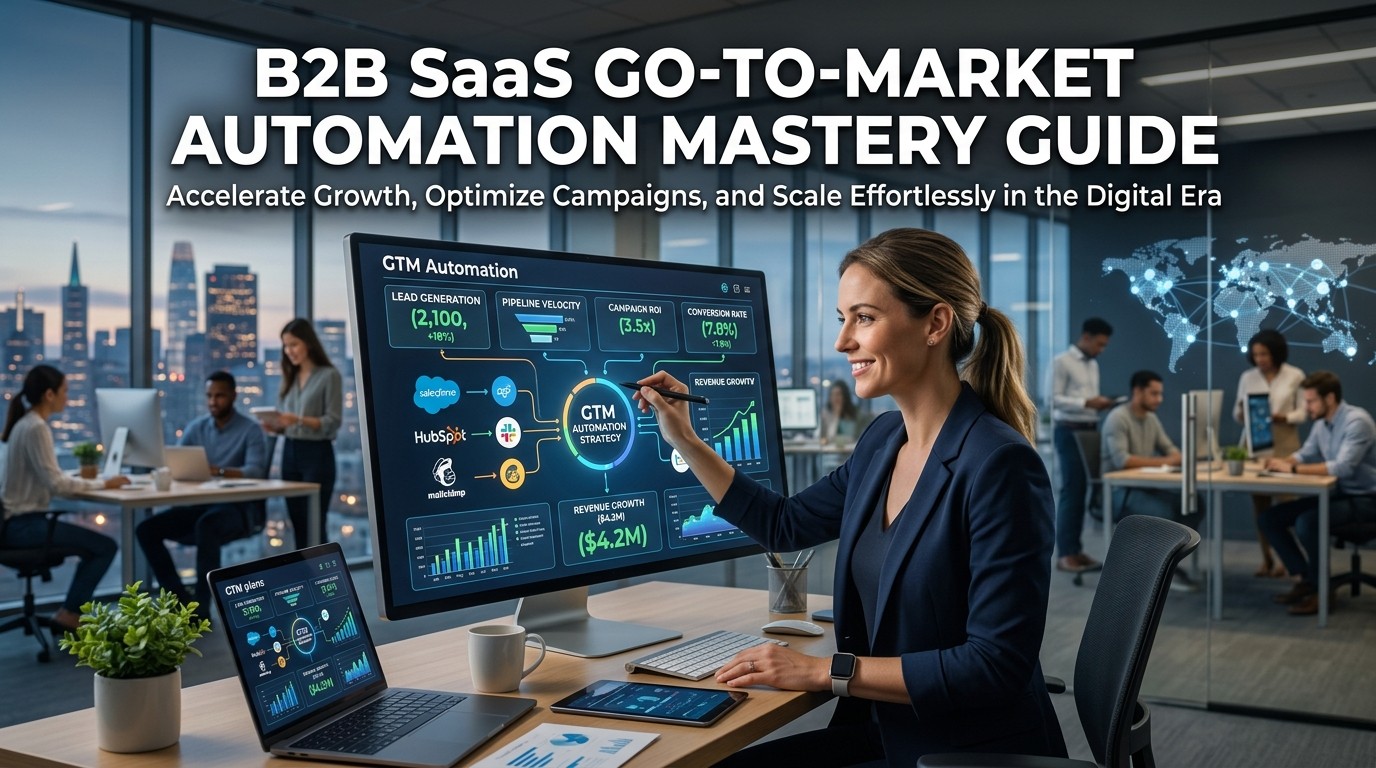
B2B SaaS companies grow faster when automation supports marketing, sales, onboarding, and analytics together. This guide explains scalable frameworks, workflows, tools, tracking systems, and optimization strategies for sustainable growth.
Modern SaaS businesses operate in one of the most competitive digital environments ever created. Every day, new products launch, buyers become more selective, acquisition costs increase, and customer expectations evolve. In this environment, manual go-to-market execution creates delays, inefficiencies, and inconsistent growth.
This is where B2B SaaS Automation becomes essential.
Automation is no longer limited to email sequences or CRM reminders. Today, high-performing SaaS companies automate lead qualification, onboarding, retention campaigns, reporting systems, analytics, customer communication, attribution modeling, and revenue optimization.
When executed correctly, automation helps businesses:
- Reduce operational friction
- Improve conversion rates
- Scale customer acquisition
- Shorten sales cycles
- Increase customer retention
- Build predictable revenue systems
The most successful SaaS organizations combine technology, psychology, analytics, and workflow automation into a unified growth engine. Instead of reacting manually to every customer action, they build systems that respond automatically based on user behavior, intent, and lifecycle stages.
This guide explores how businesses can master B2B SaaS Automation using strategic frameworks, scalable processes, and intelligent optimization systems.
What Is B2B SaaS Automation?
B2B SaaS Automation refers to the use of technology-driven workflows that automate marketing, sales, onboarding, customer success, analytics, and operational tasks inside SaaS businesses.
The goal is simple:
- Increase efficiency
- Reduce manual work
- Improve customer experiences
- Generate scalable growth
Unlike traditional automation, modern SaaS automation integrates multiple departments together. Instead of isolated workflows, companies create interconnected systems that move leads through the entire customer journey.
For example:
| Stage | Automated Action |
|---|---|
| Visitor arrives | Lead tracking begins |
| User downloads resource | CRM updates automatically |
| Lead score increases | Sales team notified |
| Trial activated | Onboarding workflow starts |
| Inactive customer detected | Retention sequence triggered |
| Expansion opportunity appears | Upsell campaign launches |
This unified structure allows businesses to operate faster while maintaining personalization.
B2B SaaS Automation also improves decision-making because automation platforms collect behavioral data continuously. Teams no longer depend on assumptions. Instead, they optimize campaigns using measurable engagement patterns.
Why Automation Matters in Modern SaaS Growth

The SaaS industry depends heavily on recurring revenue. This means businesses must continuously optimize:
- Acquisition
- Activation
- Retention
- Expansion
- Customer experience
Manual processes cannot scale efficiently across all these growth stages.
Companies that ignore automation often experience:
- Slow lead response times
- Poor sales alignment
- Low retention rates
- Reporting inaccuracies
- Revenue leakage
- High customer acquisition costs
In contrast, organizations using B2B SaaS Automation create systems that improve over time.
Automation delivers value in several important ways.
Faster Lead Response
Research consistently shows that leads convert more effectively when responses happen quickly. Automation instantly routes leads, sends personalized follow-ups, and triggers sales engagement.
This removes delays that normally reduce conversion opportunities.
Improved Customer Experience
Modern buyers expect speed, relevance, and personalization.
Automation enables businesses to:
- Deliver personalized onboarding
- Recommend relevant features
- Send behavior-based emails
- Provide contextual support
These experiences increase trust and product adoption.
Better Revenue Predictability
Automated reporting systems improve forecasting accuracy. Teams gain real-time visibility into pipeline health, churn risks, and conversion performance.
Many SaaS companies strengthen reporting systems using Attribution Tracking Analytics to identify which channels generate qualified revenue rather than vanity metrics.
Operational Scalability
Without automation, scaling often requires hiring large operational teams.
Automation allows SaaS businesses to grow efficiently by reducing repetitive manual work.
Core Components of a Successful SaaS Go-To-Market Strategy
Automation alone cannot fix weak strategy.
The best-performing organizations first design a strong GTM framework and then automate the right processes.
1. Market Positioning
Positioning determines how buyers perceive your solution.
Strong SaaS positioning answers:
- Who is the product for?
- What pain points does it solve?
- Why is it different?
- Why should buyers trust it?
Clear positioning improves every automated campaign because messaging becomes more targeted.
2. Ideal Customer Profile
A successful automation strategy depends on identifying the right audience.
Important ICP factors include:
- Industry
- Company size
- Revenue
- Team structure
- Technical maturity
- Pain points
- Buying behavior
Automation becomes significantly more effective when workflows align with customer intent.
3. Customer Journey Mapping
Modern SaaS buyers move through multiple stages:
- Awareness
- Consideration
- Evaluation
- Trial
- Adoption
- Expansion
- Renewal
Each stage requires different messaging and automation triggers.
Mapping the customer journey helps businesses identify friction points that reduce conversions.
4. Data Infrastructure
Poor data quality destroys automation efficiency.
Before scaling workflows, businesses must ensure:
- CRM consistency
- Accurate attribution
- Clean segmentation
- Event tracking reliability
- Reporting accuracy
Without reliable data, automation creates confusion rather than growth.
The Role of Automation in SaaS Marketing
Marketing automation represents one of the most valuable growth drivers in SaaS businesses.
Instead of launching disconnected campaigns, automation creates ongoing systems that nurture prospects continuously.
Lead Nurturing Automation
Not every lead converts immediately.
Automated nurturing helps businesses educate buyers over time using:
- Educational emails
- Product tutorials
- Case studies
- Webinars
- Industry insights
This builds trust before the sales conversation begins.
Behavioral Segmentation
Modern automation platforms segment users dynamically based on behavior.
Examples include:
- Pages visited
- Product interactions
- Email engagement
- Feature usage
- Trial activity
This allows businesses to personalize messaging at scale.
Content Distribution Workflows
Content marketing becomes more effective when distribution is automated.
Businesses can automatically:
- Share blog posts
- Trigger email campaigns
- Repurpose content
- Notify sales teams
- Retarget engaged visitors
Many organizations improve campaign visibility through Revenue First Audits Tracking Analytics that identify which content assets contribute directly to revenue generation.
Sales Automation Strategies for SaaS Companies
Sales teams often waste valuable time on repetitive tasks.
Automation allows sales representatives to focus on high-intent conversations instead of administrative work.
Automated Lead Scoring
Lead scoring identifies which prospects are most likely to convert.
Scoring models typically evaluate:
- Company size
- Website activity
- Email engagement
- Product usage
- Demo attendance
High-scoring leads automatically move into sales outreach workflows.
Pipeline Automation
Automation improves pipeline management by:
- Assigning leads automatically
- Updating deal stages
- Triggering reminders
- Scheduling follow-ups
- Logging communication
This creates consistency across the sales process.
Intelligent Follow-Up Systems
Many deals fail because follow-up timing is inconsistent.
Automation solves this problem by scheduling:
- Personalized sequences
- Re-engagement campaigns
- Meeting reminders
- Proposal follow-ups
This keeps opportunities active without overwhelming sales teams.
Customer Onboarding Automation
Customer onboarding significantly impacts retention.
Poor onboarding creates confusion and increases churn risk.
Strong onboarding automation helps users reach value quickly.
Welcome Sequences
Automated welcome flows introduce:
- Product features
- Setup instructions
- Tutorials
- Best practices
These sequences reduce onboarding friction.
Product Adoption Tracking
Businesses monitor product usage patterns to identify activation success.
Automation can trigger support outreach when users:
- Fail to complete setup
- Ignore critical features
- Show inactivity patterns
This proactive approach improves retention rates.
Personalized User Journeys
Different customers require different onboarding paths.
Enterprise users may need advanced workflows, while smaller teams prefer simplified guidance.
B2B SaaS Automation allows businesses to personalize onboarding experiences automatically.
Retention and Expansion Automation
Retention drives SaaS profitability.
Acquiring customers is expensive, which makes expansion and renewal strategies essential.
Churn Prevention Systems
Automation helps identify churn signals early.
Examples include:
- Reduced login frequency
- Lower feature usage
- Support dissatisfaction
- Billing issues
When risk indicators appear, automated workflows can trigger:
- Customer success outreach
- Educational resources
- Personalized check-ins
- Incentive campaigns
Upsell and Cross-Sell Automation
Expansion opportunities often emerge from behavioral data.
For example:
- Increased usage
- Team growth
- Advanced feature adoption
Automation detects these patterns and launches targeted expansion campaigns.
Renewal Workflows
Automated renewal systems help reduce revenue loss.
These workflows typically include:
- Renewal reminders
- Success reviews
- ROI summaries
- Contract notifications
This improves customer retention consistency.
Analytics and Data-Driven Automation

Analytics power intelligent automation.
Without measurable insights, workflows become guesswork.
Real-Time Reporting
Modern SaaS organizations rely on dashboards that track:
- Pipeline velocity
- Trial conversions
- Customer acquisition costs
- Retention rates
- Expansion revenue
Real-time visibility allows teams to optimize faster.
Attribution Modeling
Attribution determines which channels influence conversions.
This helps businesses allocate budgets more effectively.
Many SaaS companies invest heavily in Attribution Tracking Analytics because traditional last-click attribution often hides the real buyer journey.
Predictive Analytics
Predictive systems use historical data to forecast future outcomes.
Examples include:
- Churn prediction
- Lead conversion probability
- Revenue forecasting
- Expansion likelihood
These insights improve strategic planning.
Building an Automation Stack for SaaS Growth
Technology selection matters significantly.
The right automation stack improves efficiency, while poor tool selection creates operational complexity.
CRM Platforms
A CRM acts as the central hub for customer data.
Key CRM capabilities include:
- Contact management
- Pipeline tracking
- Workflow automation
- Reporting
- Sales forecasting
Marketing Automation Platforms
Marketing platforms manage:
- Email campaigns
- Lead nurturing
- Segmentation
- Behavioral tracking
- Campaign analytics
Customer Success Tools
Customer success platforms monitor:
- Product adoption
- Customer health
- Retention signals
- Expansion opportunities
These tools help businesses maintain long-term relationships.
Workflow Integration Platforms
Integration platforms connect multiple systems together.
This prevents data silos and improves operational efficiency.
Some SaaS organizations streamline cross-platform operations using Valcat Automation Tools to reduce workflow fragmentation and improve scalability.
Common Automation Mistakes SaaS Companies Make
Automation can accelerate growth, but poor implementation creates problems.
Automating Broken Processes
Automation cannot fix weak strategy.
Businesses must first optimize workflows manually before automating them.
Overcomplicating Workflows
Complex automation systems often become difficult to maintain.
Simple, scalable workflows usually perform better long term.
Ignoring Human Psychology
Automation should feel personalized and helpful.
Overly robotic communication reduces trust.
Successful SaaS companies combine automation with emotional intelligence.
Poor Segmentation
Generic messaging weakens engagement.
Businesses should segment audiences based on:
- Intent
- Industry
- Behavior
- Lifecycle stage
This improves personalization quality.
How AI Is Transforming SaaS Automation
Artificial intelligence is rapidly changing SaaS operations.
AI-driven systems now optimize:
- Customer segmentation
- Predictive scoring
- Content personalization
- Chatbots
- Forecasting
- Workflow recommendations
AI-Powered Personalization
AI analyzes behavioral patterns to deliver highly relevant experiences.
Examples include:
- Dynamic email content
- Product recommendations
- Personalized onboarding
- Intelligent support responses
Conversational Automation
AI chat systems now qualify leads automatically.
These systems:
- Answer questions
- Route conversations
- Schedule meetings
- Recommend solutions
This improves lead engagement speed.
Predictive Revenue Modeling
AI improves forecasting by analyzing historical trends.
Businesses gain deeper insights into:
- Revenue risks
- Expansion opportunities
- Customer health
- Pipeline performance
Some emerging SaaS growth systems integrate predictive frameworks inspired by Valcat B2B SaaS operational methodologies focused on scalable automation efficiency.
Creating a Revenue-Centric Automation Framework
The most effective automation strategies align directly with revenue goals.
Instead of measuring vanity metrics, businesses focus on revenue impact.
Revenue Operations Alignment
RevOps connects:
- Marketing
- Sales
- Customer success
- Finance
This creates unified operational visibility.
Lifecycle Automation
Revenue-focused businesses automate every lifecycle stage.
| Lifecycle Stage | Automation Goal |
|---|---|
| Acquisition | Generate qualified leads |
| Activation | Improve onboarding |
| Retention | Reduce churn |
| Expansion | Increase account value |
| Advocacy | Encourage referrals |
This creates sustainable recurring revenue growth.
KPI Monitoring
Important SaaS automation metrics include:
- CAC
- LTV
- MRR growth
- Churn rate
- Pipeline velocity
- Trial conversion rate
Consistent monitoring helps businesses optimize continuously.
Workflow Examples for B2B SaaS Automation
Below are practical workflow examples used by high-performing SaaS businesses.
Lead Qualification Workflow
- User downloads resource
- CRM creates lead profile
- Behavioral scoring activates
- High-intent activity detected
- Sales notification triggered
- Personalized outreach sequence begins
Trial User Workflow
- Trial account created
- Welcome email triggered
- Setup tutorial delivered
- Usage tracking monitored
- Inactivity alerts activated
- Upgrade offer presented
Customer Expansion Workflow
- Increased product usage detected
- Expansion score rises
- Account manager notified
- Upsell sequence triggered
- ROI case study delivered
- Upgrade consultation scheduled
These systems improve operational consistency while reducing manual workload.
Best Practices for Scaling Automation Successfully
Scaling automation requires strategic discipline.
Start Small
Businesses should begin with high-impact workflows rather than automating everything immediately.
Examples include:
- Lead nurturing
- Trial onboarding
- Retention alerts
This creates quick wins.
Measure Continuously
Every workflow should include measurable KPIs.
Without analytics, optimization becomes impossible.
Maintain Human Oversight
Automation should support human relationships, not replace them entirely.
Critical customer conversations still require personal interaction.
Prioritize Customer Experience
Automation should simplify the customer journey.
Complicated systems reduce trust and engagement.
The Future of SaaS Automation

The future of SaaS growth will become increasingly automated, predictive, and personalized.
Several trends are shaping the next generation of automation.
Autonomous Revenue Systems
Future systems will automatically optimize campaigns based on real-time data.
This reduces manual optimization requirements.
Hyper-Personalization
AI-driven experiences will become increasingly individualized.
Businesses will personalize:
- Messaging
- Pricing
- Recommendations
- Onboarding
- Support
Unified Data Ecosystems
SaaS organizations will continue integrating platforms into centralized operational ecosystems.
This improves visibility and scalability.
Predictive Customer Success
Customer success teams will increasingly rely on predictive insights to prevent churn before problems emerge.
This will improve long-term retention rates significantly.
Conclusion
B2B SaaS growth depends on speed, efficiency, personalization, and operational consistency. Businesses that rely entirely on manual execution eventually encounter scalability limitations that slow growth and reduce profitability. B2B SaaS Automation helps companies build intelligent systems that improve acquisition, onboarding, retention, analytics, and revenue optimization simultaneously. The most successful SaaS organizations combine automation with customer psychology, accurate data, strategic positioning, and continuous optimization. As AI and predictive analytics continue evolving, automation will become even more central to sustainable SaaS growth. Companies that invest early in scalable automation frameworks position themselves for long-term competitive advantage in increasingly crowded markets.
Frequently Asked Questions (FAQ)
1. What is B2B SaaS Automation?
B2B SaaS Automation refers to using automated systems and workflows to improve marketing, sales, onboarding, customer success, analytics, and operational efficiency in SaaS businesses.
2. Why is automation important for SaaS companies?
Automation improves scalability, reduces manual work, increases efficiency, enhances customer experiences, and supports predictable recurring revenue growth.
3. Which departments benefit most from automation?
Marketing, sales, customer success, onboarding, finance, and operations teams all benefit significantly from automation systems.
4. How does automation improve customer retention?
Automation identifies churn risks early, delivers proactive engagement, personalizes onboarding, and improves overall customer experience consistency.
5. What are the most important SaaS automation metrics?
Key metrics include churn rate, CAC, LTV, MRR growth, trial conversion rate, retention rate, and pipeline velocity.
6. Can small SaaS startups benefit from automation?
Yes. Even small SaaS startups can improve efficiency and scalability using simple automation workflows for lead nurturing, onboarding, and reporting.
7. What role does AI play in SaaS automation?
AI improves predictive analytics, personalization, lead scoring, customer segmentation, forecasting, and conversational automation systems.
8. How do businesses choose the right automation tools?
Businesses should evaluate scalability, integration capabilities, analytics features, workflow flexibility, ease of use, and customer support quality.
9. What is the biggest automation mistake companies make?
The biggest mistake is automating broken processes without first optimizing workflows and ensuring accurate data infrastructure.
10. What does the future of SaaS automation look like?
The future includes AI-driven personalization, autonomous optimization systems, predictive customer success, and highly integrated operational ecosystems.