
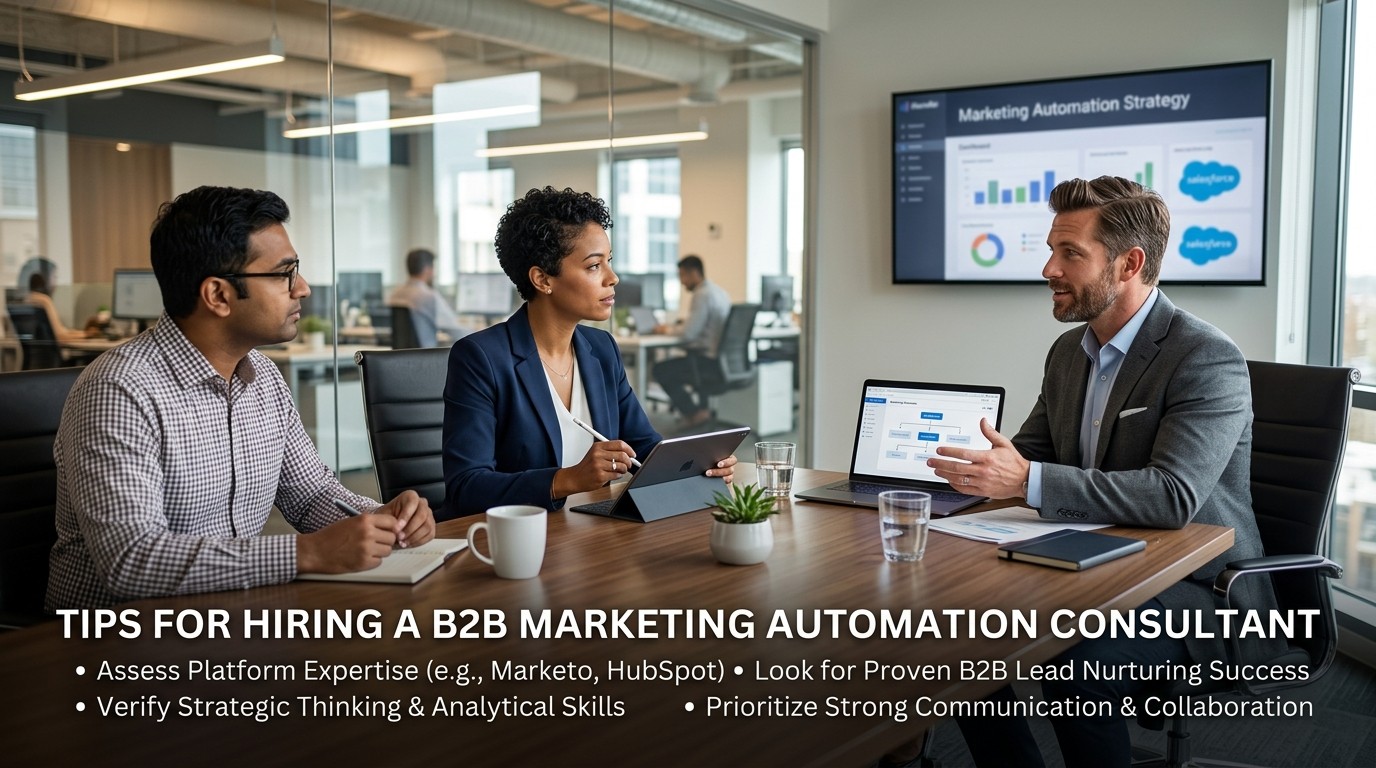
A B2B Marketing Automation Consultant helps teams turn strategy into repeatable execution by aligning systems, workflow, and reporting so revenue programs become easier to scale and easier to trust.
Hiring is usually hardest when a stack feels busy but not effective. A B2B Marketing Automation Consultant can make the work clearer by connecting the tools, data, and handoffs that already exist. Adobe says Marketo Engage is a central hub for planning, executing, and measuring omnichannel campaigns, and its documentation describes it as marketing automation software that helps streamline, automate, and measure tasks and workflows. That combination is why consultant support often becomes valuable once the team needs more than basic setup.
A B2B Marketing Automation Consultant should be evaluated as a business operator, not just a technical helper. The best consultants do more than click through screens; they clarify the buyer journey, reduce messy manual steps, and make reporting useful enough to drive decisions. Adobe’s Marketo pages emphasize real-time data, personalized experiences, and measurable impact, which shows why the role matters when teams need growth with accountability.
A B2B Marketing Automation Consultant is most useful when the company feels that campaigns are working in fragments. Email works one way, forms work another way, sales uses a different definition of readiness, and the dashboards do not tell one shared story. The consultant’s job is to turn fragments into a system that can be run, improved, and explained.
What the consultant actually does
A B2B Marketing Automation Consultant usually starts by mapping how leads move from first touch to opportunity. That includes forms, lists, nurture programs, scoring, sales alerts, lifecycle stages, and attribution. Adobe Marketo Engage is positioned as a central hub for omnichannel campaigns, and Marketo Measure is designed to measure campaign, channel, and content impact on pipeline, revenue, and ROI. Those capabilities make the platform powerful, but they also make configuration decisions important.
A B2B Marketing Automation Consultant also helps reduce hidden waste. Many teams have valuable content and active campaigns but still lose time because the workflows are too manual or too loosely defined. When that happens, the consultant identifies where segmentation, routing, scoring, or reporting is causing friction and then tightens the process.
A B2B Marketing Automation Consultant should also make the system easier for other teams to use. If sales cannot trust the lead scores, if marketing cannot explain the dashboard, or if operations cannot maintain the data structure, the stack is not mature enough. The consultant creates a bridge between the marketing operations logic and the business logic so the system is usable beyond one expert.
Why hiring matters now
A B2B Marketing Automation Consultant matters more when the company is trying to scale without losing control. Adobe says Marketo Engage helps teams scale personalized buyer engagement and grow predictable pipeline and revenue, and that it is designed to keep sales and marketing in sync. That kind of environment usually becomes more complex as the company grows, which is exactly when outside expertise can save time.
A B2B Marketing Automation Consultant also matters because growth teams often confuse motion with progress. More campaigns do not automatically mean better pipeline. More emails do not automatically mean stronger conversion. A good consultant helps the team focus on the sequence that matters: audience, relevance, trigger, follow-up, and measurement.
A B2B Marketing Automation Consultant is especially useful when leaders need a clean answer to a simple question: what is actually working? If a business cannot answer that confidently, the stack is probably collecting data without turning it into decisions. The consultant brings structure to that uncertainty.
Consultant vs agency

A B2B Marketing Automation Consultant is different from a B2B Marketing Automation Agency in both scale and style. An agency often brings more hands, more campaign production, and more execution capacity. A consultant usually brings sharper diagnosis, strategic clarity, and specialized operational insight. If the team needs a lot of asset production, agency support may help. If the team needs a clean operating model, consultant support may be the better fit.
A B2B Marketing Automation Consultant also tends to work more closely with internal teams. That can be a major advantage when the problem is not output but coordination. Agencies can deliver campaigns, but a consultant is often better at shaping the internal process so campaigns become easier to build and govern in the future.
A B2B Marketing Automation Consultant should be chosen based on the specific gap. If the company already knows the strategy and only needs production capacity, an agency may be sufficient. If the company has tools, data, and intent but no shared system, the consultant is often the smarter first hire.
Roles to expect
B2B Marketing Automation Consultant Roles usually cover more than campaign setup. In practice, the role may include lifecycle design, scoring rules, nurture planning, lead routing, reporting logic, CRM alignment, and launch QA. Adobe’s own materials show that Marketo Engage is used to automate and measure marketing workflows, which means the consultant’s work often sits at the intersection of strategy and operations.
B2B Marketing Automation Consultant Roles also usually involve translating between teams. Sales wants clarity. Marketing wants performance. Operations wants clean data. Leadership wants predictable revenue. The consultant has to understand enough of each perspective to keep the system from drifting into silos.
B2B Marketing Automation Consultant Roles can also include training. A good consultant does not keep the logic locked in their own head. They document the rules, explain the decisions, and leave the team with a system that can be maintained after the engagement ends. That is one of the best signs that the consultant was actually useful.
ABM versus demand generation
ABM vs Demand Gen is one of the most important strategy questions to settle before hiring. Adobe says account-based marketing is an alternative to traditional demand generation strategies and focuses resources on a key group of specific accounts with orchestrated campaigns personalized to those accounts. Adobe also says demand generation is about bringing more customers into the funnel, which means the two motions are related but not identical.
A B2B Marketing Automation Consultant should know how to support both motions without mixing them up. ABM needs account-level thinking, buying-committee visibility, and personalized orchestration. Demand gen needs broader reach, lead capture, and scalable nurture. If the consultant cannot explain the difference, the automation architecture may become confused very quickly.
A B2B Marketing Automation Consultant also needs to know which motion the business actually wants. If the company sells high-value deals with multiple stakeholders, ABM may be the dominant model. If the company needs broad top-of-funnel volume, demand gen may matter more. The consultant’s value is in helping the company align workflow with strategy instead of forcing one playbook on every business.
Why Adobe Marketo matters
Adobe Marketo Engage matters in this discussion because it is one of the most established B2B automation platforms in the market. Adobe describes it as a complete AI-powered marketing automation platform built to scale personalized engagement and grow predictable pipeline and revenue. It is also positioned as a central hub for omnichannel planning, execution, and measurement.
A B2B Marketing Automation Consultant should understand how Marketo Measure fits into that system. Adobe says Marketo Measure is a B2B attribution tool that measures campaign, channel, and content impact on pipeline, revenue, and ROI. That is important because consultants often inherit stacks where the challenge is not generating campaigns but proving which campaigns matter.
A B2B Marketing Automation Consultant should also know that Adobe continues to evolve the platform. Adobe’s recent Marketo roadmap and related summit sessions highlight ongoing work around AI-powered email design, lifecycle governance, CRM alignment, and omnichannel strategy. That means buyers should look for a consultant who stays current rather than relying on old habits.
How to evaluate experience

A B2B Marketing Automation Consultant should be evaluated by the problems they have solved, not by the number of buzzwords in a proposal. Ask what kinds of lifecycle problems they have handled, how they approach lead scoring, how they work with CRM data, and how they clean up broken reporting. A strong consultant can explain the tradeoffs in plain language.
A B2B Marketing Automation Consultant should also be asked how they handle scale. Adobe describes Marketo Engage as built to help teams scale personalized engagement and drive predictable pipeline, so a consultant working in that ecosystem needs to know how campaign governance, segmentation, and automation behave when volume increases. If they only know how to build one-off programs, they may not be ready for a larger team.
A B2B Marketing Automation Consultant should be able to describe the difference between a quick fix and a durable system. Quick fixes can help in the moment, but they often create future maintenance problems. Durable systems are slower to build but easier to run. The consultant you hire should understand that distinction and show evidence of building for long-term usability.
A B2B Marketing Automation Consultant should also be able to explain reporting in business terms. If they only talk about field mappings and program statuses, they may be too tactical. If they can explain how the automation stack affects cost, conversion, handoff speed, and attribution, they are likely thinking at the right level.
Questions to ask before hiring
A B2B Marketing Automation Consultant should be able to answer questions about process, not just software. Ask what a healthy lead lifecycle looks like, how they define marketing-qualified and sales-qualified states, and how they prevent list and data drift. If their answers are vague, the engagement may become messy quickly.
A B2B Marketing Automation Consultant should also be asked how they work with Adobe Marketo Engage specifically if that platform is part of the stack. Adobe’s documentation says Marketo Engage streamlines, automates, and measures tasks and workflows, so a good consultant should know where the real bottlenecks appear in implementation, reporting, and governance.
A B2B Marketing Automation Consultant should explain how they would support internal adoption. If the team cannot maintain what the consultant builds, the project loses value. Ask whether they document logic, train users, and hand off process ownership cleanly. That question often reveals whether the consultant is strategic or just technical.
A B2B Marketing Automation Consultant should also be able to describe their approach to prioritization. Good consultants do not try to rebuild everything at once. They identify the most painful bottleneck first, fix it, and then move to the next layer. That staged approach usually creates better adoption and better long-term results.
Red flags
A B2B Marketing Automation Consultant should raise concern if they promise broad results without asking enough discovery questions. If they do not want to know the current data model, the CRM setup, the campaign history, or the sales process, they are probably treating the project like a template instead of a real engagement.
A B2B Marketing Automation Consultant should also be questioned if they cannot explain how they measure success. Adobe’s Marketo Measure exists because pipeline, revenue, and ROI attribution matter in B2B. If the consultant cannot show how they would connect their work to business outcomes, the engagement may become cosmetic instead of useful.
A B2B Marketing Automation Consultant should not hide behind complexity. Some complexity is normal in automation work, but the best consultants translate it into decisions. If every answer sounds like a black box, the team may struggle to trust the work later. Transparency is one of the strongest indicators of competence.
Implementation plan
A B2B Marketing Automation Consultant should start with a diagnosis phase. First, the current state needs to be mapped. Second, the biggest friction points should be ranked. Third, the simplest high-value fix should be identified. Adobe’s Marketo docs and product pages suggest a platform that supports real-time data, personalized experiences, and connected workflows, which makes diagnosis especially important before new rules are added.
A B2B Marketing Automation Consultant should then build a staged implementation plan. That may include lifecycle changes, scoring changes, segmentation cleanup, template updates, and attribution improvements. The best order usually starts with whatever affects the largest number of leads or the largest reporting blind spot. A staged rollout prevents overwhelming the team and makes troubleshooting easier.
A B2B Marketing Automation Consultant should also leave behind governance. Governance includes naming conventions, field rules, documentation, permissions, and a review cadence. Without governance, even a strong setup can decay over time. With governance, the system stays useful after the consultant leaves.
A B2B Marketing Automation Consultant should make the final handoff simple. The team should know what changed, why it changed, and how to maintain it. If the consultant leaves behind confusion, the project did not truly finish. The best result is a system that runs more cleanly without depending on one expert forever.
Cost and ROI thinking

A B2B Marketing Automation Consultant should be judged on return, not just hours. The cost of an engagement can make sense if it improves lead quality, reduces manual work, speeds up handoffs, or makes attribution reliable. Adobe’s Marketo Measure pages emphasize connecting campaigns, channels, and content to pipeline and ROI, which is the right way to think about value in this kind of work.
A B2B Marketing Automation Consultant should also be viewed against the cost of inaction. If the team keeps operating with broken scoring, weak lifecycle design, or messy reporting, the business may keep paying that cost every month. In many cases, a consultant is less expensive than the hidden waste the team already tolerates.
A B2B Marketing Automation Consultant can produce the most value when the business is ready to act on recommendations quickly. If leadership approves the work, sales cooperates, and operations can maintain the changes, the return is usually much stronger. Consultants do their best work in companies that are ready to change, not just curious about change.
How to choose the right fit
A B2B Marketing Automation Consultant is the right fit when the company needs a sharper system, not just more activity. If the team has tools but no clear logic, a consultant can help. If the team has strategy but no execution discipline, the consultant can help again. The real question is whether the company needs a temporary helper or a structural reset.
A B2B Marketing Automation Consultant should be chosen by platform experience, business understanding, and communication style. Adobe Marketo Engage is powerful, but power alone does not create a good outcome. The consultant must understand the platform, the buyer journey, and the internal politics that make or break implementation.
A B2B Marketing Automation Consultant should leave the company more capable than before. That means cleaner workflows, better reporting, better ownership, and fewer unanswered questions. If those outcomes are not likely, the engagement should be reconsidered. A consultant is worth hiring when the work makes the whole team better, not when it creates dependency.
Conclusion
A B2B Marketing Automation Consultant is most valuable when the company wants clarity, not just activity. The right consultant can connect strategy, workflow, reporting, and ownership so the automation stack supports revenue instead of adding noise. Adobe Marketo Engage shows why this matters: it is built for planning, executing, and measuring omnichannel campaigns, scaling personalization, and connecting marketing work to pipeline and ROI. That kind of platform deserves thoughtful setup and governance. If the consultant can improve the system, train the team, and leave behind a maintainable process, the hire is usually worth it.
Frequently Asked Questions (FAQ)
1. What does a B2B Marketing Automation Consultant do?
A B2B Marketing Automation Consultant maps the lead lifecycle, improves workflows, helps with scoring and segmentation, and makes reporting easier to trust. The best consultants connect strategy and operations so the team can run the system more smoothly over time.
2. When should a company hire one?
A company should hire a B2B Marketing Automation Consultant when the stack feels fragmented, manual work is too heavy, or reporting is not showing a clear picture of performance. If the team has tools but no shared system, that is a strong signal to bring in help.
3. Is a consultant better than an agency?
A B2B Marketing Automation Consultant is usually better when the problem is diagnosis, lifecycle design, or internal coordination. A B2B Marketing Automation Agency is often better when the company needs more production capacity. The better choice depends on whether the gap is strategic or operational.
4. What should I ask during the interview?
Ask how the consultant would assess the current lifecycle, how they would improve Marketo or other tooling, how they would support sales alignment, and how they would document the handoff. Good consultants can explain their process clearly and without excessive jargon.
5. How does Adobe Marketo Engage affect the hire?
If Adobe Marketo Engage is part of the stack, the consultant should understand how it supports campaign execution, automation, real-time data, and measurement. Adobe describes it as a central hub for omnichannel campaigns and a platform that helps scale personalized engagement and predictive revenue growth.
6. What is the biggest mistake companies make?
The biggest mistake is hiring a consultant without defining the problem. If the team does not know whether it needs lifecycle cleanup, attribution help, or ABM support, the engagement can become unfocused and expensive. Clear goals make better consultant decisions.
7. How do ABM and demand gen change the job?
The consultant must know whether the company is working in ABM vs Demand Gen mode, because the automation logic changes. Adobe says ABM focuses on targeted accounts with personalized orchestration, while demand generation is broader and lead-oriented.
8. What role does attribution play?
Attribution shows whether campaigns, channels, and content actually contribute to pipeline, revenue, and ROI. Adobe’s Marketo Measure exists for that purpose, so a consultant should be able to use attribution to prove impact and improve investment choices.
9. How long should an engagement last?
A B2B Marketing Automation Consultant engagement should last long enough to diagnose the system, fix the highest-value bottleneck, and document the handoff. The exact timeline depends on the stack complexity, the team size, and how much change the business is ready to absorb.
10. What makes a consultant truly good?
A B2B Marketing Automation Consultant is truly good when the company understands the system better after the engagement, uses it more confidently, and no longer depends on the consultant for everyday interpretation. The best sign is that the team can maintain the changes without confusion.