
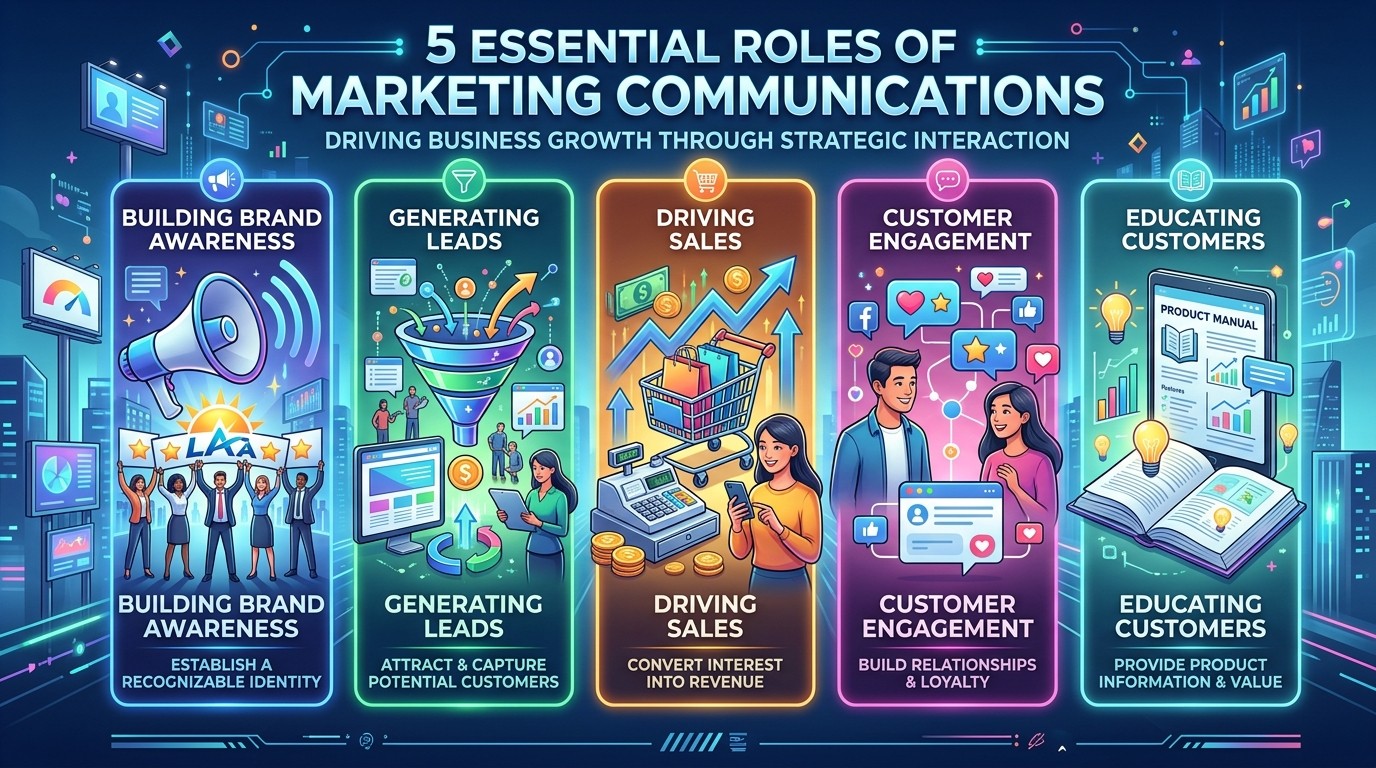
Marketing Communications helps brands align message, channels, trust, action, and measurement so customers hear one clear story across every touchpoint and feel confident moving forward.
Marketing Communications is one of the most important systems in modern brand building because people rarely buy after a single exposure. They compare, pause, revisit, and evaluate before they act. That is why Marketing Communications must do more than “talk to customers.” It has to guide them through awareness, consideration, trust, decision, and loyalty in a way that feels consistent and human. When the message stays clear across channels, the brand becomes easier to remember and easier to trust.
Marketing Communications also matters because customers do not experience a business in isolated parts. They see an ad, read a post, open an email, visit a site, and maybe speak to support later. If each step sounds different, the customer does extra mental work. Marketing Communications reduces that friction by making every touchpoint feel like part of the same conversation. That is where the real value appears: not just more visibility, but more coherence, more confidence, and more conversion.
This article breaks down the five essential roles that make Marketing Communications effective in practice. It also shows how teams can connect messaging with structure, automation, and measurement so the system supports business growth instead of creating noise. The point is not simply to “market more.” The point is to make every message work harder because it sits inside a deliberate communication design.
Clarify the brand message
The first role of Marketing Communications is to make the brand easy to understand. People do not remember everything they see, but they do remember a message that feels simple, relevant, and repeated in a useful way. When the brand promise is unclear, the audience has to guess what matters. That guessing slows down decisions. Marketing Communications removes that problem by defining what the brand stands for, who it serves, and why it exists.
This role is especially important when a company has many products, campaigns, or teams. Without a shared message, each department can drift in a different direction. Marketing Communications keeps the core story stable so the brand feels recognizable whether a person sees a social ad, a landing page, a product email, or a customer service reply. Clarity is not just a creative choice; it is a business advantage because confusion reduces action.
Why clarity changes behavior
When the audience understands a message quickly, they are more likely to keep reading, clicking, or listening. That is because the brain prefers low-friction information. Marketing Communications works best when it reduces effort rather than adding it. Clear headlines, direct promises, and consistent proof points help customers decide faster because they are not trying to decode the brand. A simple message also improves recall, which means the audience can recognize the brand later without starting from zero.
Clarity also helps internal teams. Writers, designers, paid media specialists, and sales people all need the same story to stay aligned. Marketing Communications gives them that shared base. Once the message is clear, every piece of content becomes easier to judge: does it support the promise, or does it distract from it? That question is one of the most useful filters a marketing team can have.
Connect channels into one experience

The second role of Marketing Communications is integration. A brand may use ads, email, search, events, social media, landing pages, webinars, and support content, but those channels should not feel like separate silos. The audience experiences them as one journey. Marketing Communications connects those touchpoints so the customer keeps hearing a consistent idea even when the format changes.
This is where Integrated Marketing Communications becomes highly relevant. The integrated approach means that channels are coordinated around the same strategy instead of competing for attention. A paid ad may create curiosity, a landing page may provide detail, and an email may add proof. Marketing Communications makes that sequence feel intentional, not random. The result is stronger continuity, better comprehension, and less drop-off between steps.
What integration looks like in practice
Integration is not only about using the same logo and colors. It is about message flow. If the ad talks about savings, the landing page should explain savings. If the campaign promises speed, the follow-up should reinforce speed. If the brand is positioning itself as trustworthy, the customer should see evidence of trust across the journey. Marketing Communications gives the brand a way to maintain that thread without becoming repetitive.
A strong system also prevents channel conflict. One team should not push aggressive discounts while another team emphasizes premium value if both are speaking to the same audience at the same time. Marketing Communications helps create a single point of truth for the campaign. That makes planning easier, reduces confusion, and improves the odds that the audience experiences the brand as a coherent whole.
Build trust and credibility
The third role of Marketing Communications is trust-building. Customers do not only buy because a message sounds attractive. They buy because the message feels believable. Trust grows when the brand appears consistent, informed, and honest over time. Marketing Communications supports this by repeating the same value proposition, providing proof, and avoiding exaggerated promises that cannot be supported later.
Trust is especially important in crowded markets where products look similar. The difference often comes down to how the brand communicates. Clear explanations, useful content, transparent policies, social proof, and realistic claims all strengthen confidence. Marketing Communications shapes this confidence before a person ever speaks to a salesperson. In many cases, the communication itself does the first round of selling by lowering uncertainty.
Trust is built by pattern, not one sentence
People are pattern readers. They notice whether the brand speaks clearly every time or only when it is convenient. Marketing Communications helps create a positive pattern through repeated reliability. A well-written post, a helpful FAQ, a responsive email, and a consistent offer all reinforce the same impression. Over time, that impression becomes trust.
This is also where a Marketing Business Communication Strategy becomes valuable. Business communication needs structure, because trust is not accidental. It is designed. When the strategy aligns internal messaging, customer-facing copy, and campaign logic, the audience experiences the brand as more dependable. That dependability is often what turns attention into action, especially for higher-consideration purchases.
Drive customer action
The fourth role of Marketing Communications is action. Awareness alone does not pay the bills. The message must eventually move the customer to click, subscribe, inquire, book, download, or buy. Marketing Communications supports action by making the next step clear, relevant, and low-risk. A strong message does not pressure people blindly. It shows them why taking the next step makes sense.
This is where message structure matters. A customer usually needs a reason, a benefit, and a simple call to action. If any of those pieces is missing, friction rises. Marketing Communications reduces that friction by giving the user enough context to move forward without feeling lost. The better the message flow, the easier the conversion path becomes.
Action happens when the offer feels believable and useful
Good action-driving communication does not rely only on urgency. It also relies on relevance. The customer needs to understand why the offer fits their situation now. Marketing Communications helps frame that fit. It can show how the product solves a problem, saves time, improves comfort, or creates a result the user values. Once the benefit is clear, the action becomes more natural.
This role is especially important in campaigns where multiple touchpoints work together. Marketing Communications can use one channel to introduce the problem, another to explain the solution, and a third to close the loop. That layered approach is often more persuasive than a single hard sell. It mirrors the way people make decisions in real life: gradually, with reassurance.
Support measurement and improvement
The fifth role of Marketing Communications is measurement. A communication system cannot improve if it is not measurable. Teams need to know which messages get attention, which channels produce action, and which parts of the journey create hesitation. Marketing Communications helps define what success should look like so performance can be reviewed with clarity rather than guesswork.
Measurement is powerful because it turns communication from opinion into evidence. A team may feel that a campaign is strong, but data can reveal whether the audience is actually responding. Marketing Communications gives the team a way to connect message decisions to outcomes. That connection makes future campaigns smarter because the brand learns what worked, what failed, and what should be changed next.
The feedback loop is where growth happens
The best marketing systems do not end when the campaign launches. They continue learning. Marketing Communications creates the structure for that learning by connecting the message to metrics such as clicks, conversions, open rates, leads, and retention. Once those signals are visible, the team can improve the next campaign instead of repeating the same mistakes.
This is also where small teams gain real leverage. Even with limited resources, a brand can still build a strong feedback loop if it pays attention to the right signals. Marketing Communications becomes more efficient when the team knows which message brought results and which one created friction. That knowledge is what allows the system to mature over time.
A simple view of the five roles
| Essential role | What it does | Why it matters |
|---|---|---|
| Clarify the brand message | Makes the brand easy to understand | Reduces confusion and increases recall |
| Connect channels | Aligns ads, email, web, and social | Creates one customer experience |
| Build trust | Reinforces credibility over time | Lowers uncertainty and increases confidence |
| Drive action | Moves people toward the next step | Improves conversion and response |
| Support measurement | Turns communication into learning | Makes future campaigns better |
This table makes the point simple: Marketing Communications is not one task. It is a connected system. Each role supports the others, and each role becomes stronger when the others are in place.
Why strategy matters as much as content
Many teams spend a lot of time on creative execution but not enough time on the strategic framework that holds the message together. That is where Marketing Communications can fail. The content may be attractive, but if the strategy is scattered, the audience feels it. A strong system starts with the business objective, then maps the message to the audience, then chooses the channel, then defines the action.
That is also why the phrase Marketing Business Communication Strategy matters in practice. Strategy gives the communication system direction. It decides whether the brand is trying to build awareness, launch a product, recover trust, enter a new market, or improve retention. Marketing Communications works best when the strategy is clear enough that every asset knows what job it is supposed to do.
How AI tools fit without taking over

Today, many teams use automation or creative assistance to move faster. Free AI Tools for Digital Marketing can help with draft copy, headline variations, research summaries, and content outlines. That can save time and reduce pressure on the team. But AI is only useful when it supports the communication strategy instead of replacing it. Marketing Communications still needs human judgment, because a machine can generate words without necessarily understanding tone, timing, or brand nuance.
AI works best when it is treated like an assistant, not an authority. It can speed up the process, but it should not decide the message on its own. The strongest campaigns still depend on human choices about audience intent, emotional framing, and offer quality. Marketing Communications benefits from AI when the team uses it to produce options faster and then edits those options through a strategic lens.
How small teams can still do this well
Small teams often assume they need a huge budget to build strong communication. They do not. Small Business Digital Marketing Tools can support scheduling, analytics, email, content planning, and basic automation without requiring enterprise complexity. Marketing Communications becomes practical when the team keeps the stack lean and the process simple.
For smaller brands, the key is focus. One message, one audience, one core channel mix, one measurable outcome. That is enough to create momentum. Marketing Communications is not about doing everything. It is about doing the right things in the right order. Smaller teams often win by being more consistent than bigger competitors, not by being louder.
What psychology teaches us about communication
Marketing Communications works because people are emotional and rational at the same time. They want proof, but they also want reassurance. They want a useful offer, but they also want to feel understood. Good communication respects both sides of that process. It tells the customer what the offer does, why it matters, and what happens next.
People also respond to familiarity. If the same message appears in different formats and still feels stable, they are more likely to trust it. Marketing Communications uses repetition wisely, not mechanically. It repeats the core promise while adjusting the format for the channel. That balance helps the brand feel memorable without becoming annoying.
Common mistakes to avoid
One common mistake is saying too much without saying anything specific. Another is changing the message every time the channel changes. A third is focusing on promotion while ignoring trust-building content. Marketing Communications breaks down when the team treats each campaign as a one-off event instead of part of a larger system.
Another mistake is failing to connect measurement to communication decisions. If the team never reviews what the audience actually did, then the next campaign repeats the same guesses. Marketing Communications becomes stronger when it learns from the last cycle. The goal is not perfection. The goal is improvement that compounds over time.
A practical workflow for better results

A simple workflow can make the whole system easier to manage. Start by defining the audience problem. Then write the core promise. Next, decide which channels will introduce, explain, and reinforce that promise. After that, build the content, publish it, measure the results, and review what needs to change. Marketing Communications works best when that flow is repeated consistently instead of reinvented every month.
The more often the team uses the same structure, the easier collaboration becomes. Writers know what the strategists need. Designers know what the copy is trying to do. Analysts know what should be measured. Marketing Communications becomes a shared operating system instead of a loose collection of tasks.
Final take on the five roles
When you look at the five roles together, the system becomes clear. Marketing Communications clarifies the brand, connects the channels, builds trust, drives action, and supports measurement. Those are not separate tasks. They are a sequence of effects that work best when they support one another. If one role is weak, the rest become harder. If one role is strong, the others become more effective.
That is why the best communication plans are simple at the core and disciplined in execution. They do not rely on luck. They rely on repeatable structure, audience understanding, and a clear path from message to result. Marketing Communications gives the business that path.
Conclusion
Marketing Communications matters because it turns scattered brand activity into a focused system that people can actually follow. When the message is clear, the channels are aligned, trust grows naturally, action becomes easier, and measurement improves the next round of work. That is what separates a busy brand from an effective one. The five essential roles are not abstract theory; they are the practical foundation of campaigns that people notice, understand, and respond to. Businesses that treat Marketing Communications as a strategic system usually create less confusion, more consistency, and better long-term results. In a crowded market, that kind of clarity is not just helpful. It is a competitive advantage.
Frequently Asked Questions (FAQ)
1. What is the main purpose of Marketing Communications?
The main purpose is to create a clear, consistent message that helps people understand the brand, trust it, and move toward action.
2. How is Marketing Communications different from advertising?
Advertising is one channel or tactic, while Marketing Communications is the broader system that connects all customer-facing messages across channels.
3. Why is Integrated Marketing Communications important?
It ensures that all channels support the same story, which reduces confusion and makes the brand easier to recognize and trust.
4. How does a Marketing Business Communication Strategy help?
It gives the communication plan direction, so every message supports a specific business goal instead of existing as random content.
5. Can Free AI Tools for Digital Marketing improve communication?
Yes, they can speed up drafting and idea generation, but human review is still needed to protect tone, strategy, and brand consistency.
6. Are Small Business Digital Marketing Tools enough for good marketing?
Yes, if they are used with discipline and a clear message. Small teams often succeed by being consistent and focused rather than overly complex.
7. What is the most important role of Marketing Communications?
All five roles matter, but clarity is often the starting point because people cannot respond well to a message they do not understand.
8. How does Marketing Communications build trust?
It builds trust by repeating a believable promise, using useful proof, and staying consistent across channels over time.
9. Why is measurement part of communication?
Because communication should improve over time, and measurement shows which messages and channels are actually working.
10. How can a team improve Marketing Communications quickly?
Start with a single clear message, align every channel to it, and review the results so the next campaign is stronger and more focused.