
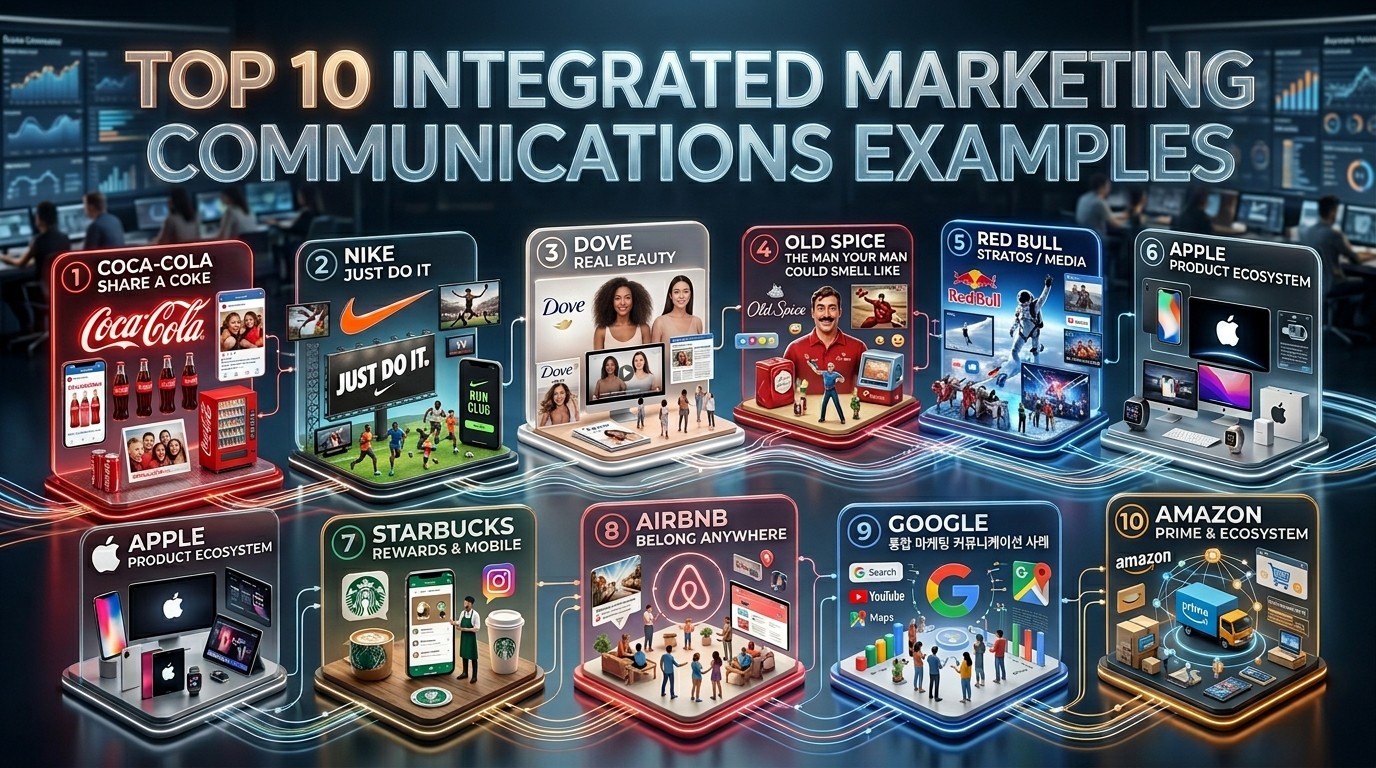
Integrated Marketing Communications Examples show how one clear brand message can move through ads, email, social, PR, content, and sales touchpoints to build trust and action.
Integrated Marketing Communications Examples matter because modern buyers do not experience a brand through a single channel. They see a social post, open an email, compare a landing page, notice a retargeting ad, and maybe hear about the brand from a friend. When those moments feel connected, the message becomes believable. When they feel disconnected, the brand feels scattered. That is why the best campaigns are not just creative; they are coordinated.
Integrated Marketing Communications Examples also matter because consistency reduces cognitive load. People remember messages better when the tone, promise, and visual style stay aligned. A campaign that repeats the same core idea across channels does not feel repetitive to the audience; it feels reassuring. That psychological effect is why stronger brands often look simple from the outside. The communication is not random. It is deliberately sequenced.
A useful way to think about Integrated Marketing Communications Examples is to view them as systems rather than isolated campaigns. A business can run a great ad, but if the landing page, follow-up email, and sales conversation do not support the same promise, the opportunity weakens. Good communication architecture creates momentum. It helps people move from awareness to interest to action without feeling pushed.
In practice, Integrated Marketing Communications Examples are useful because they translate strategy into lived customer experience. Every touchpoint should reinforce the same core idea, even if the format changes. A short social video may create curiosity. A blog post may explain the value. A sales deck may deepen trust. A customer testimonial may remove doubt. Together, they create a persuasive chain.
What makes a communication plan integrated
Integrated Marketing Communications Examples usually work best when the brand uses one message map. That map defines the audience, the problem, the proof, and the call to action. When teams follow the map, they can adapt the language for each channel without changing the meaning. That is where integration becomes practical rather than theoretical.
Integrated Marketing Communications Examples also depend on timing. A message that is helpful at discovery may be too early for conversion. Good orchestration respects the buyer journey. It gives the audience the right information at the right time.
Integrated Marketing Communications Examples succeed when channel owners collaborate instead of optimizing in silos. The paid media team, email team, content team, and sales team should all understand the same campaign story. If one team speaks in features, another in discounts, and another in emotional benefit, the audience receives mixed signals. A coherent system avoids that problem.
A simple framework before the examples

Integrated Marketing Communications Examples become easier to evaluate when you ask four questions. What is the single brand promise? Which audiences need to hear it? Which channels will carry it? What proof will make it believable? If those answers are clear, the campaign can stay consistent while still being flexible.
Integrated Marketing Communications Examples also benefit from measurement. Brands should track reach, engagement, assisted conversions, direct response, and post-campaign recall where possible. Measurement tells you whether the message worked and which channels helped most. It also reveals whether the communication stayed aligned or drifted as it moved across the journey.
A strong communication strategy is not only external. Internal alignment matters too. Teams need the same campaign brief, the same terminology, and the same approval rules. That is why Marketing Business Communication Strategy matters so much in larger organizations. When everyone uses the same language, execution becomes faster and more accurate.
Example 1: Launch campaign with coordinated teasers
Integrated Marketing Communications Examples often begin with a product launch. In a strong launch, the brand might tease a coming announcement on social media, build anticipation through email, publish a landing page, and brief the sales team at the same time. The customer sees one growing story rather than a random burst of content. That is the first sign of integration.
Integrated Marketing Communications Examples like this work because curiosity is amplified by repetition across channels. A social teaser sparks attention. An email adds context. A press release gives authority. A landing page captures interest. Each piece performs a different job, but all of them support the same outcome.
Integrated Marketing Communications Examples in launch marketing should avoid overexplaining too early. The first touchpoint can be light and intriguing. Later touchpoints can provide detail and social proof. This sequencing respects attention and makes the final call to action feel earned rather than forced.
Example 2: Seasonal campaign with one message across every touchpoint
Integrated Marketing Communications Examples are especially powerful in seasonal promotions. A brand can build a holiday or event-based campaign around one core benefit, then carry that theme through ads, email headers, product banners, and social captions. The audience experiences the campaign as one connected moment.
Integrated Marketing Communications Examples in seasonal work are effective because timing already creates urgency. The communication simply channels that urgency into a consistent brand story. When every asset shares the same colors, offer, and promise, the campaign becomes easier to remember.
Integrated Marketing Communications Examples also reduce friction in seasonal messaging because teams do not have to invent a new concept for every channel. Instead, they adapt the same idea with different levels of depth. That saves time and creates a stronger overall impression.
Example 3: Rebranding with synchronized internal and external messaging
Integrated Marketing Communications Examples are not limited to product promotion. A rebrand also needs coordination. The company may need to update the website, social bios, sales decks, customer emails, and internal training materials at the same time. If one channel updates while another stays behind, the brand feels confused.
Integrated Marketing Communications Examples in a rebrand work best when employees understand the story first. Internal communication should explain why the change matters, how to talk about it, and what customers will see. Once the team is aligned, external communication becomes more confident and consistent.
Integrated Marketing Communications Examples of rebrands often show the value of timing. Customers need continuity, not surprise for its own sake. A well-managed transition keeps the promise familiar even while the visual identity changes. That keeps trust intact during a sensitive moment.
Example 4: Education-led content campaign
Integrated Marketing Communications Examples can also be built around thought leadership. A company may publish educational articles, host webinars, send nurturing emails, and share short social clips that all reinforce one teaching theme. The brand becomes useful before it becomes persuasive, which often creates deeper trust.
Integrated Marketing Communications Examples in education-led campaigns work because people appreciate value without pressure. The brand is present, but not pushy. It answers questions, clarifies problems, and helps the audience feel informed. That emotional experience improves receptivity later when an offer appears.
Integrated Marketing Communications Examples in content programs also help sales teams. When buyers have already seen the educational material, the sales conversation can go deeper faster. The campaign has already done part of the relationship-building work.
Example 5: Retail promotion with online and offline consistency
Integrated Marketing Communications Examples become very visible in retail promotions. A store may run a display, a coupon email, a social promotion, and a local ad campaign that all point to the same offer. If the creative and wording match, customers move more easily between channels and locations.
Tracking Tools For Sales Integrated Marketing Communications Examples are particularly effective in retail because shoppers often switch between browsing and buying modes. A visual reminder in the store, a message in the inbox, and a retargeting ad can reinforce one another. The customer feels that the offer is real because it appears everywhere relevant.
Integrated Marketing Communications Examples like these also benefit from operational discipline. Inventory, signage, pricing, and customer service all need to match the campaign promise. If the ad says one thing and the store experience says another, the result is friction.
Example 6: B2B webinar funnel with multi-stage messaging
Integrated Marketing Communications Examples in B2B often rely on webinars because they allow a brand to educate, demonstrate, and convert in one sequence. A social post may invite attention, a landing page may explain the topic, an email reminder may improve attendance, and a follow-up sequence may carry the conversation forward.
Integrated Marketing Communications Examples in webinar funnels work well when each stage has a purpose. The invitation creates curiosity, the event builds authority, and the follow-up turns interest into next steps. That order matters because B2B buying usually requires more trust and more evidence.
Integrated Marketing Communications Examples in B2B should also support the sales team. When attendees receive consistent messaging before and after the event, sales calls feel smoother. The buyer already recognizes the story, which lowers resistance and shortens the path to action.
Example 7: Cause-driven brand campaign
Integrated Marketing Communications Examples are often strongest when the brand stands for something meaningful. A cause-driven campaign may combine social storytelling, email education, donation pages, employee participation, and media outreach. The brand message becomes emotionally richer because it connects commerce with purpose.
Integrated Marketing Communications Examples in cause campaigns work when the purpose is believable and aligned with the brand. People can quickly sense when a message feels opportunistic. But when the action, the story, and the proof line up, the campaign can create genuine goodwill.
Integrated Marketing Communications Examples also show that purpose should not be confined to a single ad. It should appear in customer service language, on the website, and in follow-up communication. That breadth is what makes the message feel real.
Example 8: Product tutorial ecosystem
Integrated Marketing Communications Examples can center on helping users succeed. A software brand, for example, may pair onboarding emails with tutorial videos, help-center articles, in-app prompts, and social tips. The communication is integrated because each touchpoint reinforces the same learning path.
Ecommerce Data Accuracy Tracking Analytics & Integrated Marketing Communications Examples in tutorial ecosystems are powerful because they remove friction. Instead of making users search for answers, the brand anticipates questions and solves them. That increases product confidence and reduces churn.
Integrated Marketing Communications Examples like this are also excellent for retention. When customers understand the product better, they use it more successfully. That positive experience creates better reviews, stronger referrals, and higher lifetime value.
Example 9: Event marketing with layered reminders
Integrated Marketing Communications Examples frequently appear in event promotion. The campaign might start with a teaser, move into registration emails, follow with reminder messages, support the event through social live coverage, and finish with a recap. Each step nudges the audience closer to participation.
Integrated Marketing Communications Examples in event marketing succeed because they reduce forgetting. People are busy, and most events are not attended because the content is bad; they are skipped because attention drifts. Repeated reminders across different channels help the event stay visible.
Integrated Marketing Communications Examples also help the event feel larger than the invitation itself. A coordinated campaign creates energy, legitimacy, and momentum. That emotional effect increases attendance and improves the post-event memory of the brand.
Example 10: Loyalty and retention campaign
Integrated Marketing Communications Examples are not only about acquisition. A loyalty campaign can use personalized emails, app notifications, social exclusives, and customer service scripts that all reinforce appreciation. The customer should feel recognized, not just marketed to.
Integrated Marketing Communications Examples in loyalty marketing are effective because retention is emotional as much as functional. People stay with brands that make them feel seen, valued, and rewarded. A coordinated message can strengthen that feeling across multiple touchpoints.
Integrated Marketing Communications Examples in retention programs also help companies protect revenue. Existing customers usually cost less to keep than new customers cost to acquire. That makes the loyalty stage one of the most strategic places to use integration well.
How to build your own integrated campaign

Integrated Marketing Communications Examples become more useful when you convert them into a process. Start by defining the audience and the business goal. Then choose one central message, one proof point, and one action. Once those are set, adapt the message for each channel instead of changing the meaning.
Integrated Marketing Communications Examples also benefit from a message hierarchy. The shortest version should fit ads and social posts. The medium version should fit landing pages and email. The long version should fit webinars, sales decks, or explainers. The hierarchy keeps the brand consistent while allowing depth where needed.
Integrated Marketing Communications Examples should be reviewed before launch and after launch. Before launch, check for consistency in tone, visuals, and claims. After launch, study which channels helped most and where the story weakened. That feedback loop improves the next campaign.
What the channels should do
| Channel | Main job | What integration looks like |
|---|---|---|
| Social media | Create attention | Same story, same tone, repeated visually |
| Build depth | Adds detail and next steps | |
| Paid ads | Expand reach | Reinforces the same core promise |
| Website | Convert interest | Clarifies value and proof |
| Sales | Personalize persuasion | Uses the same language and evidence |
| PR | Add credibility | Supports the same brand narrative |
Integrated Marketing Communications Examples are strongest when the audience never has to re-learn the meaning of the campaign. The message should feel familiar in every format, even when the wording changes. Familiarity creates trust, and trust creates movement.
Why this matters for psychology
People like patterns because patterns reduce uncertainty. Integrated Marketing Communications Examples work partly because the brain notices repetition and treats repeated messages as more credible. A consistent story feels safer than a fragmented one, especially when the customer is deciding whether to buy, subscribe, or respond.
Integrated Marketing Communications Examples also reduce the mental effort required to understand the offer. When the same promise appears across channels, the customer does not need to re-interpret the message every time. That ease is powerful. The lower the mental friction, the more likely the person is to continue engaging.
Integrated Marketing Communications Examples are especially persuasive when the message progresses naturally. A first touch can build awareness, the next can build confidence, and the final one can ask for action. That progression feels respectful because it mirrors how people actually make decisions.
Where teams usually fail
Integrated Marketing Communications Examples can fail when teams move too quickly without a shared brief. One group may emphasize features, another may push discounts, and another may focus on brand emotion. The audience receives multiple messages and may not know which one is supposed to matter most.
Integrated Marketing Communications Examples also fail when metrics are disconnected. If the team tracks reach in one place, leads in another, and sales in a third, nobody sees the full story. The campaign might still perform, but the learning value drops. Integration is as much about measurement as it is about messaging.
Integrated Marketing Communications Examples are also weakened by inconsistent visuals. When the color palette, imagery, or tone changes too much across assets, the campaign loses recognition. The best programs treat visual continuity as part of the message itself.
Practical checklist for execution
Integrated Marketing Communications Examples should always have a campaign owner. Someone needs to keep the message brief, approve the channel adaptations, and maintain consistency from launch to recap. Without ownership, even good ideas can drift into confusion.
Integrated Marketing Communications Examples also need clear assets. Brand headlines, proof points, visuals, and CTA language should all be ready before production begins. That preparation saves time and protects coherence when multiple teams are involved.
Integrated Marketing Communications Examples become more reliable when each channel knows its role. No single platform needs to do everything. The point is to create a sequence of support, where each touchpoint strengthens the next one.
Communication across the organization

Integrated Marketing Communications Examples are easier to execute when the whole organization understands the campaign. Customer support, product teams, sales, and leadership should all know the core message. That helps every customer-facing interaction feel aligned.
Integrated Marketing Communications Examples can also improve internal morale. Teams work better when they know the story they are contributing to. People prefer to feel part of a coordinated effort rather than a set of isolated tasks.
Integrated Marketing Communications Examples remind leaders that communication is not decoration. It is the path by which the brand becomes understandable. When that path is clear, the business becomes easier to trust and easier to choose.
Final thoughts on choosing the right pattern
Integrated Marketing Communications Examples do not need to be flashy to be effective. They need to be clear, coordinated, and emotionally coherent. The strongest campaigns often look simple because the complexity is hidden behind the scenes. The audience should feel guided, not managed.
Integrated Marketing Communications Examples are valuable because they show how one message can travel through many channels without losing meaning. That is the real skill of modern marketing. It is not just making noise. It is building a story that stays intact while reaching people in different places, at different times, and with different needs.
Conclusion
Integrated Marketing Communications Examples show that successful marketing is rarely about one perfect message in one perfect place. It is about repetition, timing, and coherence across the full customer journey. When every touchpoint reinforces the same promise, the brand becomes easier to understand and harder to ignore. That consistency builds trust, and trust improves action. Whether the goal is awareness, lead generation, sales, or loyalty, integration gives the campaign more power than isolated tactics ever could. The best teams treat communication as a system, not a collection of disconnected tasks. That mindset creates stronger performance and a smoother experience for the customer.
Frequently Asked Questions (FAQ)
1. What are Integrated Marketing Communications Examples?
They are real campaign patterns that show how a brand uses multiple channels with one consistent message to create a smoother customer experience and stronger results.
2. Why are they important?
They matter because customers interact with brands across many touchpoints. A unified message improves recall, trust, and conversion by making the experience feel connected.
3. What channels are usually included?
Common channels include social media, email, paid ads, websites, sales conversations, PR, events, and customer support. The exact mix depends on the campaign goal.
4. How do I make a campaign integrated?
Start with one core promise, one audience, one proof point, and one action. Then adapt the message for each channel without changing the meaning.
5. What is the biggest mistake teams make?
The biggest mistake is letting every channel say something different. If the story keeps changing, customers have to work harder to understand the offer.
6. How do you measure integration?
Look at reach, engagement, assisted conversions, direct response, and channel consistency. The goal is to see whether all the touchpoints support the same outcome.
7. Can small businesses use this approach?
Yes. Even simple campaigns can be integrated if the website, email, social posts, and sales messaging all reinforce the same offer and tone.
8. Is integration only for big launches?
No. It works for launches, promotions, educational content, rebranding, loyalty campaigns, and event marketing. Any campaign benefits from consistency.
9. How does this help customer trust?
People trust brands that feel clear and predictable. When the same story appears in multiple places, it feels more reliable and less confusing.
10. What should I do first?
Define the campaign goal and write a short message brief. Once that foundation is clear, the rest of the channels become much easier to align.