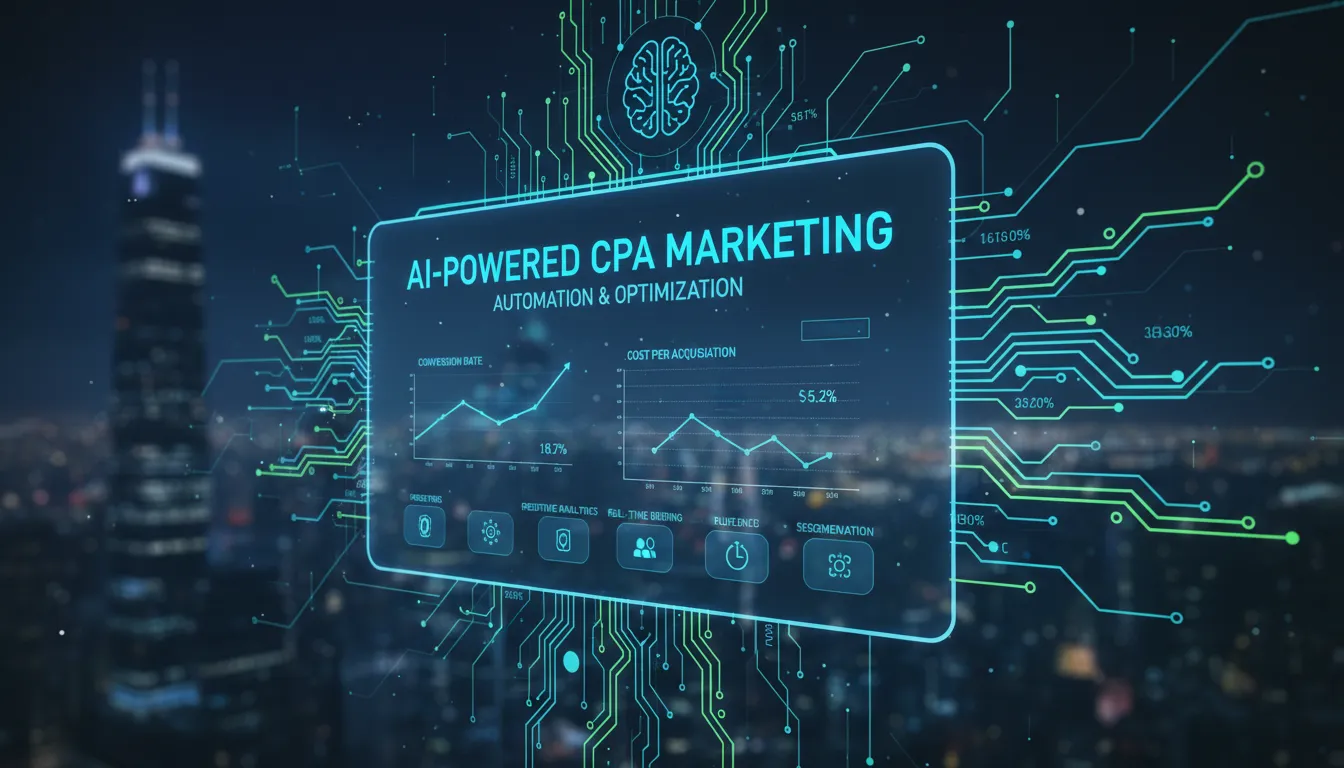
AI-powered CPA marketing leverages machine learning and predictive analytics to automate bidding and personalize creatives, significantly reducing acquisition costs while maximizing conversions and ROI through real-time, data-driven optimization.
In today’s digital landscape, competition for consumer attention has never been fiercer. Marketers are constantly seeking innovative approaches to enhance performance, reduce costs, and streamline processes. One strategy that has emerged as a game-changer is AI-powered CPA marketing. By leveraging artificial intelligence to automate bidding, personalize creative assets, and predict user behavior, businesses can optimize their campaigns at scale while maintaining a clear focus on cost per action (CPA). In this article, we’ll dive deeply into the world of AI-powered CPA marketing, examining how machine learning, predictive analytics, and natural language processing combine to drive smarter decisions. We’ll also explore best practices for choosing the right tools, implementing them into your workflow, and measuring success against defined objectives. Whether you’re new to automated advertising or looking to enhance an existing program, this comprehensive guide provides the insights you need to stay ahead in today’s rapidly evolving ad ecosystem. Organizations that prioritize data-driven strategies gain a significant competitive advantage. Let’s explore how to harness the power of AI-powered CPA marketing for sustainable growth and improved return on ad spend (ROAS).
The Role of AI in CPA Marketing
AI-powered CPA marketing transforms manual ad management into a dynamic, self-optimizing process. At its core, AI leverages three primary technologies: machine learning (ML), predictive analytics, and natural language processing (NLP). Together, these capabilities analyze vast datasets—capturing user behavior, demographic signals, and contextual factors—to identify patterns that humans might overlook. By feeding real-time performance data into ML models, marketers can shift from reactive adjustments to proactive strategies, ensuring campaigns align with evolving audience preferences.
Machine Learning for Bid Optimization
One of the most impactful use cases for AI in CPA marketing is automated bidding. Traditional bid strategies rely on static rules or manual tweaks, which can overlook critical fluctuations in user activity. Machine learning models continuously ingest performance signals—such as time of day, device type, and geographic location—and adjust bids to maximize conversions. For example, an ML engine might detect that mobile users convert at a higher rate during lunch hours. It can then raise bids during that period, ensuring the budget is allocated where it matters most. This adaptive approach reduces manual intervention and drives more efficient spend in today’s fast-paced ad environment.
Predictive Analytics for Audience Targeting
Predictive analytics uses historical data to forecast which prospects are most likely to complete a desired action, whether it’s a signup, download, or sale. By assigning conversion probability scores to individual users, marketers can allocate budget more precisely, focusing on high-value prospects and lowering overall CPA. Academic research from institutions such as the National Institute of Standards and Technology confirms that predictive models outperform human intuition by spotting subtle signals in big data that hint at purchase intent. Incorporating these insights into your AI-powered CPA marketing strategy ensures you target audiences with the greatest return potential.
Key Benefits of Automating CPA Campaigns

Adopting AI-powered CPA marketing brings a host of advantages that extend well beyond traditional digital advertising techniques. By automating repetitive tasks and leveraging data-driven decision-making, teams can focus on high-level strategy and creative innovation. Below are the most compelling benefits to consider when evaluating an AI-first approach.
- Scalability: Automation frees your team from manual bid adjustments and budget reallocations, enabling you to launch and manage a greater number of campaigns simultaneously without adding headcount.
- Speed: AI algorithms process and interpret vast volumes of data in real time, instantly adapting to shifting market conditions and delivering optimized performance across channels.
- Consistency: Automated systems follow predefined rules consistently, eliminating the risk of human error and ensuring reliable outcomes across multiple ad accounts.
- Cost Efficiency: By identifying and targeting only high-intent segments, AI reduces wasted ad spend, resulting in lower CPAs and improved return on ad spend (ROAS).
- Insight Generation: AI-driven dashboards highlight trends and anomalies, helping teams uncover hidden opportunities and optimize creative assets more effectively.
According to research published by Stanford University, campaigns that integrate machine learning for bid management see up to a 30% reduction in CPA compared to manually managed efforts. These numbers underscore why AI-powered CPA marketing is rapidly becoming a cornerstone for forward-thinking advertisers.
Leveraging AI-Driven Personalization
In today’s marketplace, personalization extends far beyond addressing an email with the recipient’s name. With AI-powered CPA marketing, you can deliver hyper-relevant messaging at every touchpoint, creating a seamless user journey from ad click to conversion. Below, we outline three key tactics for implementing AI-driven personalization at scale.
Dynamic Creatives
Dynamic creative optimization (DCO) leverages AI to assemble ad components—headlines, images, and calls to action—in real time based on user attributes. For instance, a visitor in New York might see one set of visuals emphasizing local offers, while someone in California views a different creative tailored to regional preferences. By continuously testing and refining these combinations, DCO engines improve click-through rates and lower cost per acquisition over time.
Adaptive Landing Pages
Adaptive landing pages use AI scripts to modify content dynamically according to the visitor’s referral source or browsing behavior. If a user arrives from a social media ad highlighting a product demo, the landing page can automatically display a signup form for that demo, boosting relevance and conversion likelihood. This level of customization drives higher engagement and helps ensure your CPA goals are met more consistently.
AI Chatbots for Lead Qualification
AI chatbots provide an interactive layer on your website, guiding visitors through a series of qualification questions and answering frequently asked questions instantly. By capturing contextual data and user intent, chatbots can route high-quality leads directly to your sales team while nurturing less-ready prospects with targeted messaging. This not only reduces drop-off rates but also enhances the overall user experience, contributing to a lower CPA in today’s competitive environment.
Selecting the Right AI Tools and Measuring Success

With a crowded marketplace of AI platforms, choosing the right solution for your CPA campaigns can feel overwhelming. The following criteria will help you evaluate options effectively and integrate them into a structured workflow that minimizes risk and accelerates learning.
- Integration Capabilities: Ensure the platform seamlessly connects with major ad networks—such as Google Ads and Meta Ads—as well as your CRM and analytics stack.
- Transparency & Control: Look for tools that provide clear, auditable reports on AI-driven changes and allow for manual overrides when needed.
- Scalability & Pricing: Compare subscription-based models against performance-based fees to identify the best fit for your ad spend and growth projections.
- Feature Set: Prioritize platforms offering bid management, creative optimization, predictive modeling, and real-time dashboards to cover all aspects of AI-powered CPA marketing.
Once you’ve selected an AI solution, follow a phased rollout process to guide deployment:
- Audit Existing Campaigns: Record current benchmarks—CPA, conversion rate, click-through rate—across channels and audience segments.
- Set Clear Objectives: Define specific goals for AI adoption, such as reducing CPA by a set percentage or increasing conversions by a target amount.
- Pilot on Low-Risk Campaigns: Allocate a small budget to test AI-driven recommendations, ensuring you understand system behaviors before scaling.
- Iterate Quickly: Review performance data, adjust model parameters, and refine audiences based on insights from the pilot phase.
- Scale Gradually: Expand successful pilots into core campaigns, diversifying across channels and markets for maximum impact.
Implementing AI-powered CPA marketing is only half the battle; diligent performance tracking ensures your initiatives deliver tangible business value. Monitor these key performance indicators (KPIs) to assess effectiveness and guide ongoing optimization:
- Actual vs. Target CPA: Compare real-world CPA against AI-driven targets to evaluate bid strategy accuracy and cost efficiency.
- Conversion Rate by Segment: Analyze which demographics, devices, or traffic sources exhibit the highest lift under AI personalization.
- ROAS & ROI: Calculate revenue generated per dollar spent, confirming that lower CPAs translate into sustainable profitability.
- Ad Frequency & Quality Score: Ensure that automated bid increases do not inflate frequency caps or degrade quality scores on ad networks.
- Model Accuracy & Drift: Periodically retrain your ML models with fresh data to maintain performance and prevent drift over time.
By establishing a rigorous measurement framework, you can validate that AI-powered CPA marketing efforts align with broader business objectives, making data-driven adjustments as needed to sustain growth throughout this year (2026).
Frequently Asked Questions
How exactly does “Machine Learning” differentiate AI-powered CPA marketing from traditional auto-bidding?
Traditional auto-bidding often relies on simple “if-this-then-that” rules. In contrast, AI-powered CPA marketing uses deep learning to process thousands of variables simultaneously—including historical conversion patterns, weather data, and real-time site behavior. It doesn’t just follow rules; it “learns” which unique combination of factors predicts a conversion, allowing it to bid more aggressively for high-value prospects.
What is “Predictive Audience Scoring” and how does it lower CPA?
This technique uses AI to assign a numerical value to a user’s likelihood of converting before they even click your ad. By integrating this into your AI-powered CPA marketing strategy, you can avoid wasting budget on “window shoppers” and focus your spend exclusively on users whose digital footprints suggest a high probability of completing your desired action.
How does Dynamic Creative Optimization (DCO) enhance the user journey?
DCO is the ultimate personalization tool. It uses AI to mix and match ad components (headlines, background images, CTAs) in real-time. This ensures that a user interested in “budget-friendly” options sees price-focused copy, while a user seeking “premium quality” sees luxury-focused visuals, significantly increasing the relevance and conversion rate of every impression.
Can AI help with “Attribution Modeling” in a cookieless world?
Yes. As third-party cookies disappear, AI-powered CPA marketing fills the gaps using “probabilistic modeling.” It analyzes anonymized data clusters to predict which touchpoints—like a YouTube view followed by a Google search—actually led to a conversion, giving you a much clearer picture of your true CPA across different channels.
What are the risks of “Model Drift” in automated marketing?
Model drift occurs when the AI’s predictions become less accurate because consumer behavior has shifted (e.g., a sudden change in economic trends). To maintain a successful AI-powered CPA marketing program, you must regularly feed the system fresh data and perform manual audits to ensure the AI’s “logic” still aligns with current market realities.
How do AI-driven “Adaptive Landing Pages” work?
When a user clicks an AI-optimized ad, they shouldn’t land on a generic page. Adaptive landing pages use AI to swap out headlines, images, or lead forms to match the specific ad creative the user just saw. This seamless “scent” from ad to landing page is a core tactic to boost conversion rates and lower your overall cost per action.
How does Natural Language Processing (NLP) assist in creative writing?
NLP tools can analyze thousands of top-performing ad headlines in your niche to suggest copy that is most likely to resonate with your target audience. In AI-powered CPA marketing, NLP is used to generate hundreds of variations of ad copy, which are then A/B tested automatically to find the winning “voice” for your brand.
What is the “Black Box” concern, and how do you mitigate it?
Many marketers fear that AI makes decisions they can’t see or explain (the “Black Box”). To solve this, prioritize “Explainable AI” tools that provide clear logs of why a bid was raised or a creative was swapped. This transparency is crucial for maintaining control over your AI-powered CPA marketing budget and strategy.
How does AI improve “Lead Qualification” for B2B marketers?
In B2B, a high CPA often comes from low-quality leads. AI-powered lead scoring systems analyze incoming data from contact forms against your CRM history to instantly flag “Sales Ready” leads versus “Junk.” This allows you to optimize your AI-powered CPA marketing for lead quality rather than just lead volume.
What are the best practices for a “Hybrid” AI strategy?
The most successful advertisers don’t just “set it and forget it.” A hybrid approach involves using AI for the heavy lifting—like bid adjustments and data processing—while humans handle the creative direction, brand voice, and long-term business goals. This synergy ensures your AI-powered CPA marketing remains both efficient and authentically human.
Conclusion
AI-powered CPA marketing represents a transformative shift for advertisers seeking efficiency, scalability, and lower acquisition costs. By automating bid strategies, personalizing creative experiences, and leveraging predictive insights, you can outpace competitors and drive sustainable growth. Start by selecting the right tools, pilot on low-risk campaigns, and build a robust measurement plan to ensure your AI initiatives deliver measurable value. In today’s data-driven landscape, embracing AI is no longer optional—it’s essential for marketers aiming to achieve smarter campaigns, higher conversions, and optimal return on ad spend.